Editor’s Choice
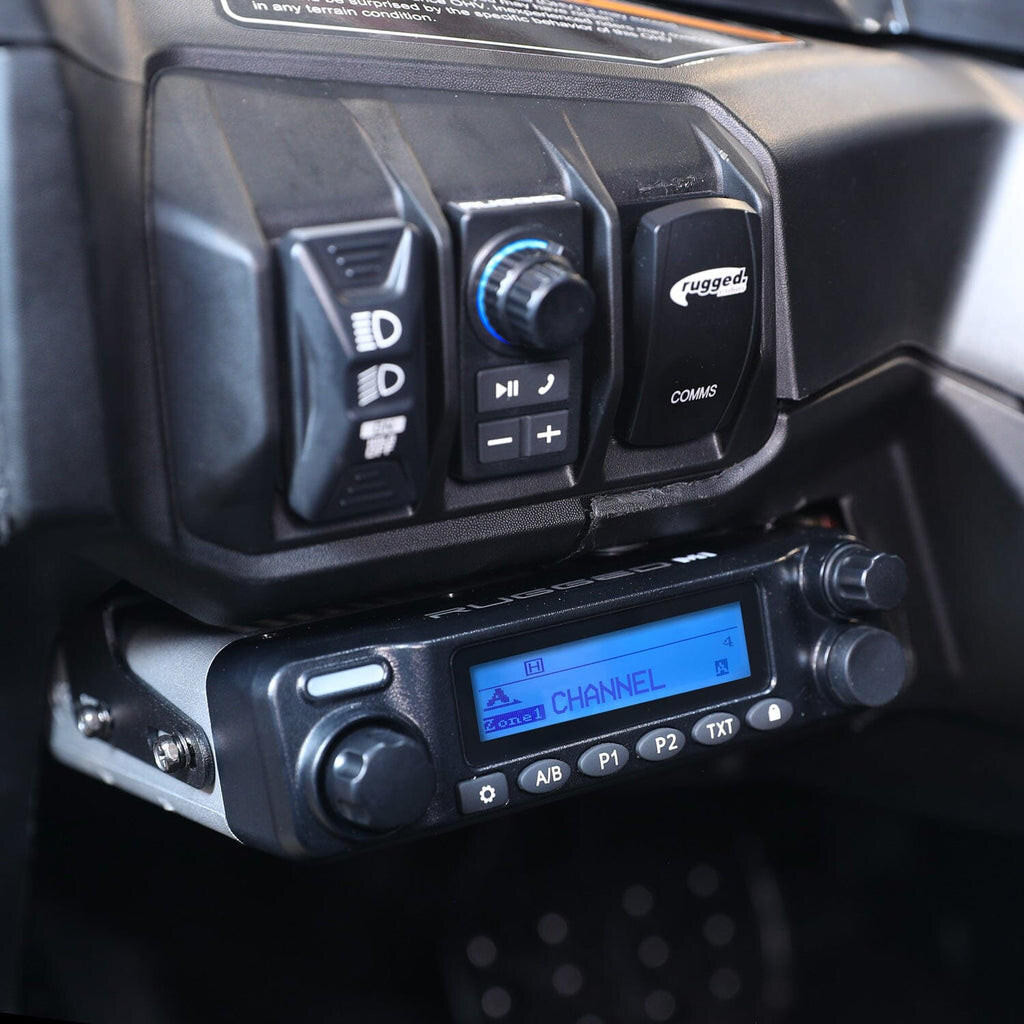
Rugged Radios GMR25 Kit Lite
25-watt GMRS mobile with stealth antenna. IP67 waterproof, 15 GMRS channels plus 8 repeater channels and 7 NOAA weather channels.
See PickGMRS mobile radios, complete vehicle-specific kits, and a wireless intercom that doesn’t need a license — matched to how you actually ride and who you ride with.
Four radio and intercom systems covering the most common UTV communication setups. Every pick is in-stock, IP-rated for the trail, and ships ready to install with the wiring or mounts the kit calls for.
25-watt GMRS mobile with stealth antenna. IP67 waterproof, 15 GMRS channels plus 8 repeater channels and 7 NOAA weather channels.
See PickBundled GMRS radio + external antenna at our entry price point. The cheapest path to a real mobile radio with vehicle-mount range.
See PickVehicle-specific dash mount, 696PLUS intercom, GMRS radio, headsets, antenna, and cabling. The plug-and-play option for current Polaris sport platforms.
See PickBluetooth-mesh intercom by JBL audio, IP67, up to 1 mile rider-to-rider, 15-rider mesh group. License-free and helmet-free with the right mount.
See PickStop comparing thumbnails. The differences that decide whether your radio setup actually works on a ride are band, power, mount type, and headset integration. Most listicles dodge these.
GMRS is the right answer for most UTV buyers: a $35 ten-year FCC license, external antennas allowed, repeater-capable, and the band most groups use. Business band needs a per-business license but offers cleaner audio in dense areas. CB is dying for UTV use.
Handheld GMRS units max out at 5 watts and 1–3 mile line-of-sight range. A 25-watt mobile (like the Rugged GMR25) clears 10–12 miles in flat terrain. 50W mobiles exist but pull more current and rarely make a meaningful difference on a UTV battery.
A vehicle-specific complete kit (Polaris Pro XP, Maverick X3) drops in to a factory dash with no fabrication. Universal kits give you the same radio + intercom but require you to source mounts, drill, and route wiring yourself. The labor savings on the kit pay for the bundle markup.
If you ride with a full helmet, headsets that thread into the helmet liner give the best noise rejection and music quality. If you ride open or with a baseball-cap headset, look for over-the-head or behind-the-head (BTH) headsets or wireless mesh systems like Cardo Packtalk that ship with non-helmet mounts.
Five complete systems our product team curates for the buyer journeys most UTV owners actually take. Every pick is verified against the manufacturer’s current spec sheet and in-stock as of this update.
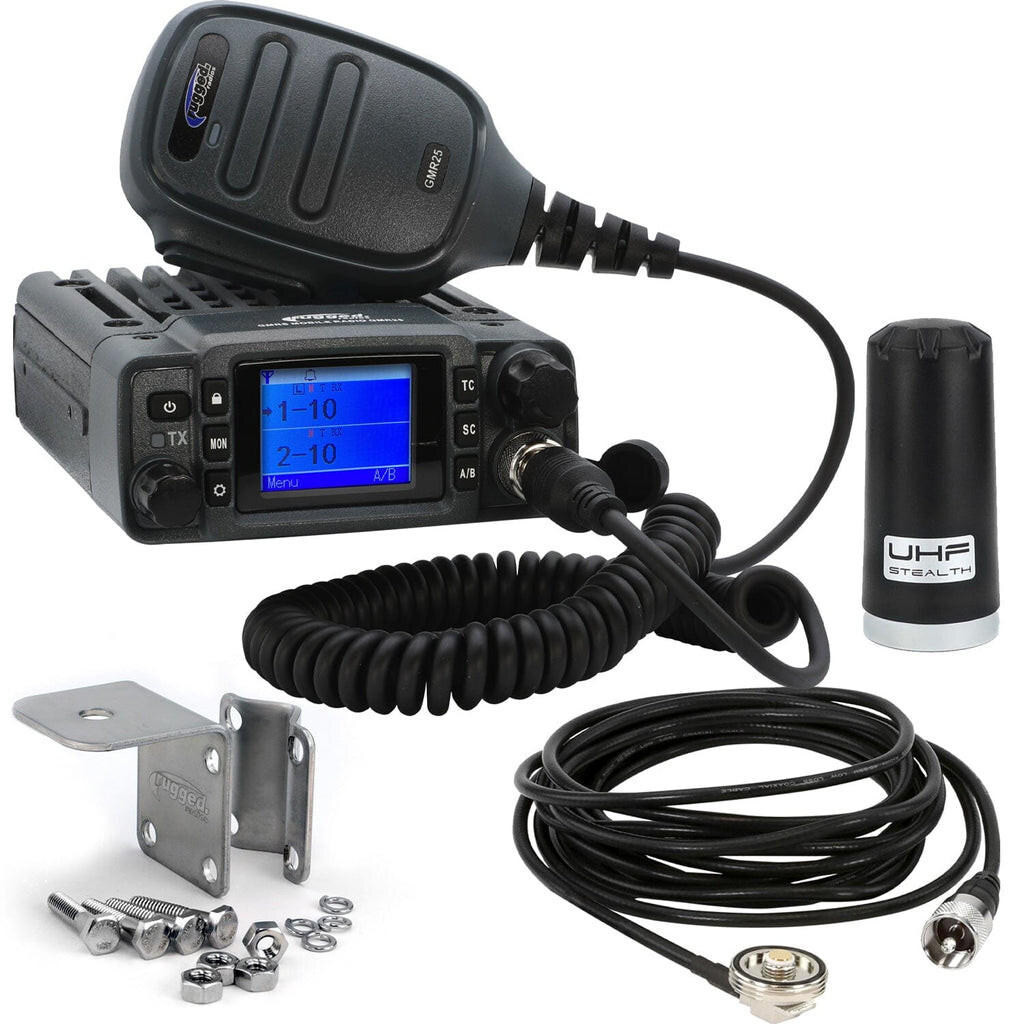
The GMR25 is the radio we recommend to most UTV buyers starting from scratch. 25 watts on transmit, IP67 waterproof, and pre-programmed with 15 GMRS channels, 8 repeater channels, and 7 NOAA weather channels. The “Kit Lite” bundle pairs the radio with Rugged’s stealth antenna — a low-profile option that mounts cleanly on a roll cage tube without screaming “race car.”
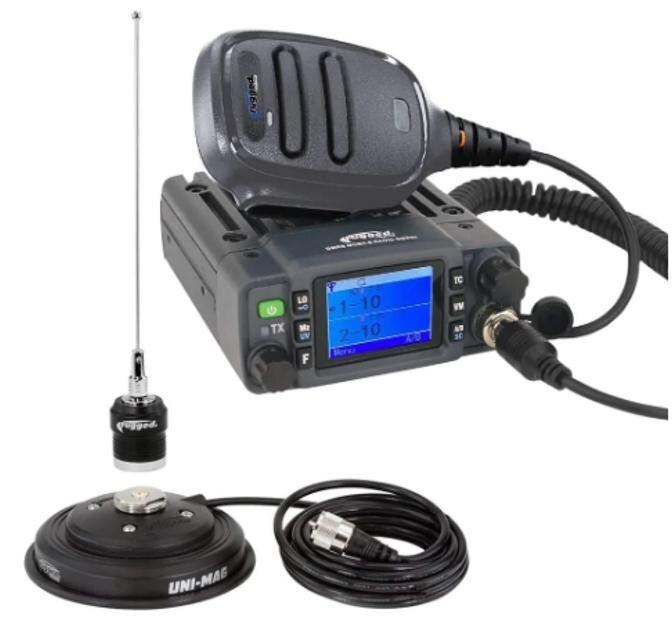
Our most affordable path to a real vehicle-mounted GMRS radio. The kit pairs Rugged’s GMR25 mobile radio with an external antenna and mounting cable. You give up the small stealth antenna — in exchange for under-$330 entry pricing. A solid first radio for trail riders graduating from a handheld.
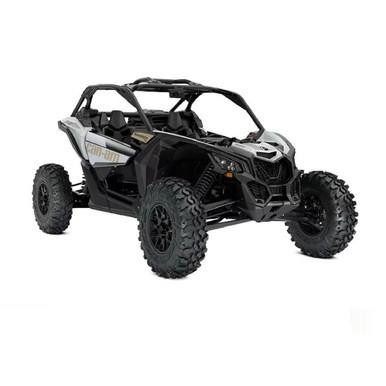
The plug-and-play option for the Can-Am Maverick X3. Bundled with a vehicle-specific dash mount, the 696PLUS intercom, a 25W GMRS radio, headsets, antenna, and wiring — no fabricating brackets and no figuring out the routing. Drops into a factory X3 dash in an afternoon and works the moment you connect power.

The same complete-kit treatment Rugged Radios gives the X3, ported to the current Polaris sport platforms. One part number covers Pro XP, Turbo R, and Pro R; the vehicle-specific dash mount drops into the factory location, and the 696PLUS intercom plus 25W GMRS radio handle the rest. The kit our product team installs most often in customer Pro R builds.
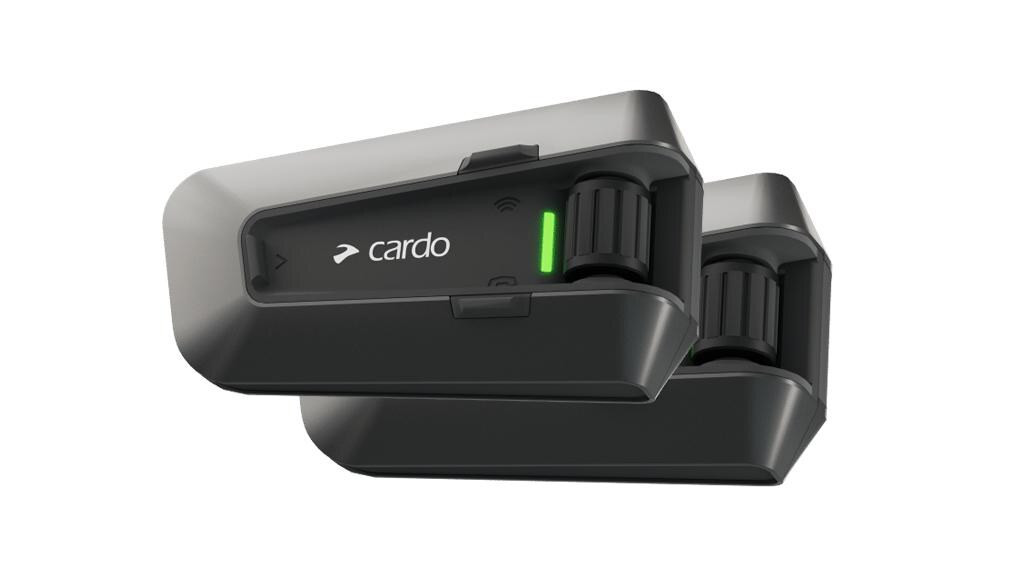
The completely different answer. Cardo’s Packtalk Edge ORV is a wireless Bluetooth-mesh intercom — no FCC license, no antenna, no wiring into the dash. Two-unit Duo pack pairs in under a minute, holds up to 15 riders in a mesh group, gets about a mile rider-to-rider, and the JBL 40mm speakers actually sound like music. The pick for families and casual trail crews who want talk-to-passenger comms without committing to a radio license.
Radios run universal hardware — the kit you need depends on your dash and harness. Rugged Radios builds plug-and-play complete kits for the top sport platforms. For utility machines, the GMR25 universal kit drops in cleanly.
One kit covers all three Pro-chassis RZRs. The Rugged Radios Complete Communication Kit was engineered for the Pro XP and fits the Pro R and Turbo R natively — same dash mount, same plug-and-play harness, intercom + 2-way radio in one package.
$1,653
Full intercom + 2-way kit with native dash fitment on all three Pro-chassis RZRs.
The X3 gets its own Rugged Complete Communication Kit — same intercom + 2-way bundling but with X3-specific dash mounts and harness.
$1,688
X3-specific dash mount, harness, intercom + 2-way radio.
The Maverick R gets its own Rugged Radios Complete Communication Kit — rocker-switch intercom plus 2-way radio with Maverick R-specific fitment, the same plug-and-play formula as the X3 kit.
$1,753
Maverick R-specific complete kit — rocker-switch intercom + 2-way radio, plug-and-play.
Utility platform — closed cab, lower noise floor. GMR25 mobile is the standard choice for ranch work and hunting comms. No complete kit needed.
$328
Waterproof GMRS mobile with antenna. Mounts cleanly under a Defender visor or dash.
Same logic as the Defender — utility comms, no dedicated complete kit on shelf. GMR25 mobile is the practical pick. Cardo Packtalk Edge ORV if you only need helmet-to-helmet intercom.
$799.95
Wireless helmet-to-helmet intercom with JBL audio. No dash install, no harness, no antenna.
Four common riding patterns. Each maps to a different priority — range, intercom integration, no-license simplicity, or full vehicle-specific install. Use this grid to anchor your decision before brand-comparing.
Riding alone or with one friend on a different machine. You need range to reach help and to talk to the rider in front of you on a different rig.
Four to eight machines on a desert run or rally. You need machine-to-machine GMRS plus intercom inside each rig so drivers and passengers can plan turns together.
Closed-course or open desert racing. You need helmet-integrated headsets, hard-wired intercom for the driver-co-driver loop, and a real 25W mobile radio for chase comms.
Weekend rides with the kids or close friends. You don’t want an FCC license or a dash radio install. Wireless intercom + music is the right call.
Radio and intercom decisions stack on each other. Skip the wrong question at the top of the funnel and you’ll be returning headsets or buying a second antenna. Walk this five-step check before checkout.
The most common return we see is a buyer who chose a mobile radio kit when they actually wanted a complete kit with a vehicle-specific dash mount — or vice versa. Step 1 is the most important.
GMRS is right for almost every UTV buyer. Business band only makes sense if you’re part of a fleet or club that’s already on it. CB and FRS are not worth installing in 2026. Talk to your regular riding group — whatever they’re on is what you should pick.
If you need range beyond a mile or two, you want a mobile GMRS radio. If you only need intercom between rider and passenger and 1-mile rider-to-rider in a group, the Cardo wireless path skips the license and the wiring entirely.
A standalone GMRS radio (like the GMR25 Kit Lite) is the cheapest path if you’ll only be driving solo and don’t need a passenger headset. If you ride with the same passenger every weekend, the complete kit (intercom + radio + headsets in one bundle) saves money and install time.
Polaris Pro XP, Pro R, Turbo R, and Can-Am Maverick X3 owners should default to the vehicle-specific complete kit — the dash mount alone justifies it. Owners of older or less-common machines may need to start with a universal bracket from our mounts category.
Full-face helmet riders should pick helmet headsets that integrate into the liner. Open-cab or baseball-cap riders should look at over-the-head or behind-the-head BTH headsets. Wireless mesh (Cardo) skips this entirely with helmet-or-non-helmet mounts in the box.
Land directly on the radio + intercom subset that fits your machine. Each tile filters our Audio & Communications category to a single vehicle hub so you’re one click from add-to-cart.
Yes. The FCC requires a General Mobile Radio Service license to transmit on GMRS frequencies above 2 watts. The license costs $35, covers your entire immediate family, and is valid for 10 years. No test is required — you fill out the application on the FCC ULS site and receive your call sign in a few days. Riders who use a GMRS radio without a license risk an FCC fine, though enforcement is rare in practice.
A radio sends and receives signals from other radios outside your machine (other UTVs, base stations, repeaters). An intercom connects the people inside your machine so the driver and passenger can talk over the engine noise. Complete kits (like the Rugged Polaris or X3 kits we recommend) bundle both: the intercom box ties the headsets together and patches into the GMRS radio so anyone in the car can transmit to the group.
Range depends on power, antenna, and terrain. A handheld GMRS radio at 5 watts gets you roughly 1–3 miles line-of-sight. A 25-watt mobile GMRS like the Rugged GMR25 reaches 10–12 miles in flat desert and dune terrain, less in mountains and dense forest. Repeaters can extend GMRS range to 30+ miles if your area has them. Wireless intercoms like Cardo Packtalk top out around 1 mile rider-to-rider through their mesh network.
Both are reputable brands and both are widely used. The honest comparison: Rugged tends to win on customer service, warranty, and the breadth of vehicle-specific complete kits (we carry far more Rugged dash-mount kits than PCI). PCI tends to win on stereo intercom audio quality and on Kenwood-radio integration for race builds. If you’re building a trail or weekend rig, the Rugged complete kits are easier to install and harder to regret. If you’re building a dedicated race car and audio quality matters more than convenience, PCI is worth pricing out. Forum debates on this are eternal and mostly reflect what each rider bought first.
Yes. Cardo’s Packtalk Edge ORV ships with mounting hardware for both helmeted use and the “Edgephones” non-helmet headphone set sold separately. The unit itself snaps via magnetic Air Mount onto either a helmet or the Edgephones. If you ride open-cab or in a baseball cap, plan to add the Edgephones ORV to the Packtalk Duo at checkout.
GMRS is the clear answer for UTVs in 2026. CB radio is older, lower-fidelity, more susceptible to skip and interference, and has a smaller and shrinking community of users. GMRS gives you cleaner audio, higher power limits (up to 50W mobile vs CB’s 4W), external antennas, and repeater compatibility. The only reason to choose CB over GMRS is if your specific riding group already runs CB and won’t switch.
For a typical weekend trail rider in a group of 4–6 machines staying within a couple miles of each other, a 5W handheld is enough. For desert, dunes, long-format rides, or any scenario where you might get separated from the group by more than 3 miles or need to reach a base camp, the 25W mobile is the right call — the extra range is exactly what saves the day when someone breaks down out of handheld range. Almost no one regrets the 25W after the first long ride.
Plugging a radio kit into your machine’s 12V system using a fused tap or accessory plug does not void the unrelated portions of your manufacturer warranty. Damage that traces directly back to the radio install (e.g., shorting the wiring harness) can affect coverage on the electrical system. Polaris, Can-Am, Honda, Yamaha, and Kawasaki each have their own policy; the vehicle-specific complete kits we recommend are designed to plug into factory-supported accessory taps and rarely cause warranty issues. See our UTV winch buyer’s guide for more on accessory wiring best practices.
Shop our full Audio & Communications catalog, browse radio + intercom kits by vehicle, or talk to a UTV Source tech if you need a fitment confirmation before you order.