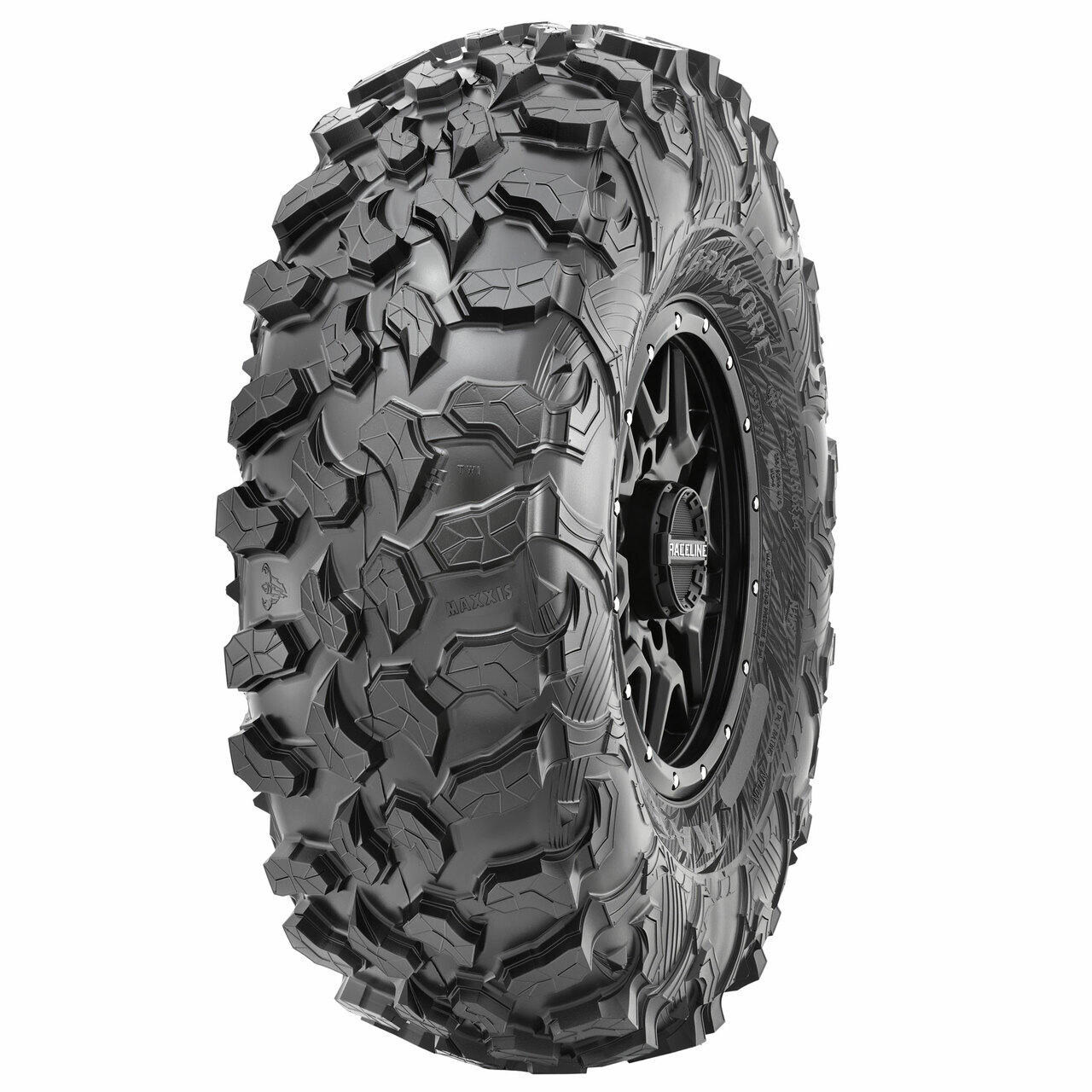
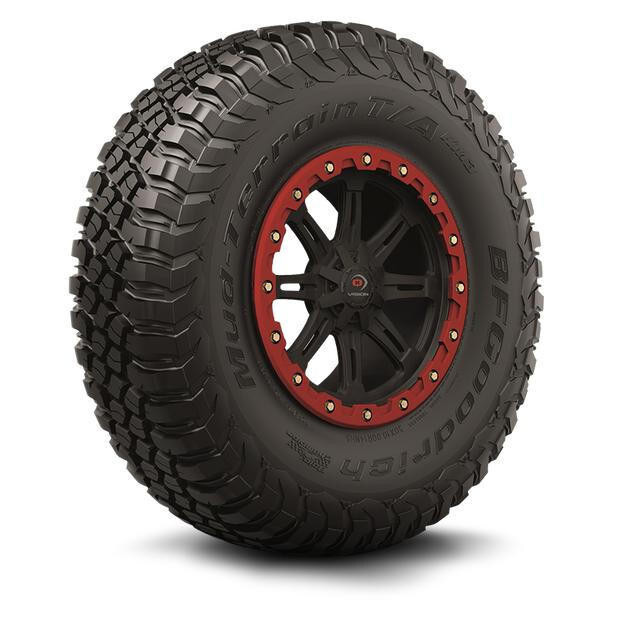
Six dimensions matter most for picking between these two. Here’s how each plays out in real–world riding.
Tread Depth & Longevity
The Carnivore runs 23/32″ of tread on every 14″ and 15″ size (22/32″ on the two 17″ sizes). The BFG KM3 runs 18/32″ across every size. That’s a 28% advantage in raw tread material for the Carnivore — meaningful for trail–tuned riders who churn miles in soft terrain.
That said, BFG’s engineering thesis is the inverse: shallower tread + a harder rock–biased compound = less wear under the conditions that punish tires hardest (rocks, hardpack, dry dust). Owner reports on KRX Forum and RZR Forums consistently show 8,000–15,000+ miles on KM3s in western terrain, while east–coast clay–mud riders sometimes report faster wear on the same tire.
Edge: Maxxis Carnivore for raw tread material; tie on real–world longevity (depends entirely on terrain)
Weight, Rotational Mass & Ride Feel
BFG publishes exact tire weights per size: 33.4 lbs (27x9R14) up to 52.3 lbs (35x11R15). Comparable–size Carnivores run about 3–10 lbs lighter each. On a four–corner setup, that’s 12–40 lbs of unsprung rotational mass. Riders feel that immediately in acceleration response, deceleration distance, and CVT belt temperature on long climbs.
For high–horsepower turbo sport builds where every ounce of rotational mass costs measurable acceleration (RZR Pro R, Pro XP, Turbo R, Maverick X3, Maverick R), the Carnivore is the better answer. For utility–biased machines where load carrying matters more than acceleration (Ranger XP 1000, Defender HD10, Pioneer 1000), the weight of the KM3 actually benefits the application by adding mass to the contact patch under load.
Edge: Maxxis Carnivore for sport builds; BFG KM3 for utility loads
Mud & Snow Traction
The KM3 was engineered around the Mud–Phobic Bars feature: raised rubber ridges between the tread blocks that mechanically pop compacted mud out of the void. The result is a tire that keeps biting in wet, packing soils where Carnivore’s more–open void layout can spin under load.
The caveat is east–coast clay. Owner threads (RZR Forums, Maverick Forums) show the KM3 can pack and spin in heavy, slick clay–mud where neither tire excels. For pure mud terrain, dedicated paddle–mud tires (think ITP Mud Lite or Maxxis Bighorn 2.0 in deeper sizes) usually beat both of these.
For snow and slush, the deeper Carnivore tread void traps more snow for the snow–on–snow grip mechanism that aggressive UTV tires rely on. Owner reports favor the Carnivore here as well, though the gap is smaller than on bare hardpack.
Edge: BFG KM3 for mixed/sand mud; Maxxis Carnivore for snow and slush
Rock & Hardpack Durability
This is where BFG’s engineering shows its racing roots. The KM3 sidewall combines two published technologies: a Linear Flex Zone (compliant rubber that envelops sharp rocks aired–down without splitting) and Advanced Deflection Design (a curved sidewall geometry that deflects branch and rock snags rather than catching them). Owners running western rock country consistently rate the KM3 as best–in–class for puncture resistance.
The Carnivore has a reinforced sidewall but Maxxis doesn’t publish equivalent features. Owner reports on KRX Forum show puncture incidents on Carnivores in sharp–rock terrain that don’t reproduce on KM3s in the same conditions.
Edge: BFG KM3, decisively
Pressure Capacity & Load Rating
The BFG KM3 is rated for up to 42–46 PSI across sizes — a substantial pressure range. The Carnivore caps at 18 PSI. That’s a meaningful difference for two scenarios: long highway transfers (where higher pressure rolls more efficiently and runs cooler) and loaded utility work (where higher pressure prevents sidewall flex under cargo).
The KM3 also publishes per–tire load ratings up to 2,002 lbs @ 44 PSI on the 32x10R14, which is well above the maximum corner load of most modern sport UTVs and approaches the load demands of full–cab utility machines hauling cargo and passengers.
Edge: BFG KM3, especially for utility and cargo builds
Available Sizes & Big–Rim Fitment
The Carnivore covers 14″, 15″, and 17″ rim diameters with 10 size combinations — including the 35x10R17 and 37x10R17, which are the answer for lifted sport builds running 17″ beadlocks. The BFG KM3 stops at 15″ rims (12 sizes total), with the 35x11R15 as the largest available.
Riders building on 18″ wheels — most notably the Can-Am Maverick R, which ships with 32″ tires on 18″ beadlocks — will find neither tire fits the stock wheel; both require a downsize to 15″ or 17″ wheels. That’s a fitment limitation worth flagging up front.
Edge: Maxxis Carnivore for 17″ rim builds and 36″–37″ tall sport setups