2026 Kawasaki Ridge Complete Accessories & Build Guide: What to Buy and in What Order!
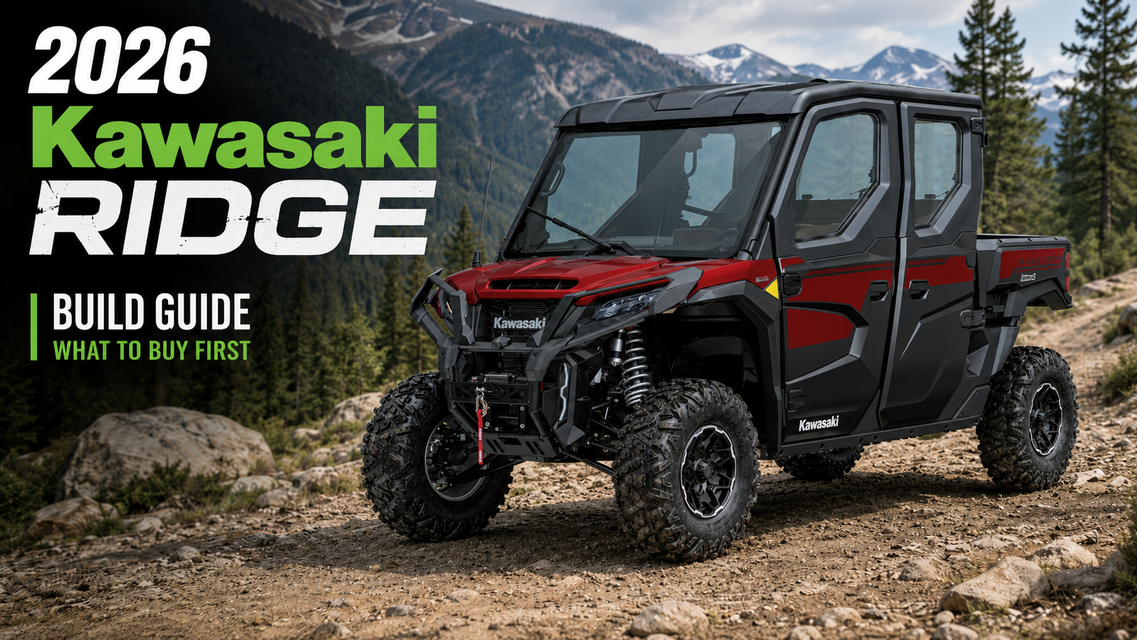
The 2026 Kawasaki Ridge Build Guide: What Actually Matters
The 2026 Kawasaki Ridge is Kawasaki's entry into the full-size, work-and-play side-by-side segment that has been dominated by the Polaris Ranger XP, Can-Am Defender, and Honda Pioneer. With a 999cc inline-four, true 4WD, a tilt bed, and a chassis built around a 2,500-lb towing rating, the Ridge is positioned as a do-everything machine. The platform supports trim levels from base HVAC to the fully-loaded XR Limited HVAC Camo and Platinum Ranch Edition HVAC.
This guide walks through what actually matters when building one out. Protection first, then capability, then comfort. UTV Source is skipping the obvious stuff anyone can pull from the owner's manual and focusing on what experienced UTV owners want to know before they start spending.
Know Your Ridge Before You Build
Kawasaki refreshed the Ridge for 2026, expanded the lineup, and added a long list of new standard features. The differences affect what accessories fit and which you actually need.
Two-door Ridge trims:
- Ridge HVAC
- Ridge ST HVAC (entry-level, lower-output engine)
- Ridge XR HVAC
- Ridge XR Limited HVAC
- Ridge XR Limited HVAC Camo
- Ridge Platinum Ranch Edition HVAC (factory WARN winch)
Four to six-passenger Ridge Crew trims:
- Ridge Crew HVAC
- Ridge Crew ST HVAC
- Ridge Crew XR HVAC
- Ridge Crew XR Limited HVAC
- Ridge Crew HVAC Camo
- Ridge Crew Platinum Ranch Edition HVAC
New for 2026 across the lineup:
- Front stabilizer bar standard on all trims except ST
- Idle collar bar on the primary pulley shaft for less belt flutter and quicker throttle response (all trims except ST)
- Updated CVT ratios
- Cabin sound-dampening rubber sheeting
- Rearview camera feeding the 7-inch TFT display (all trims except ST)
- Lower seat height and revised driver ergonomics
Platform specs to keep in mind when shopping parts:
- Engine: 999cc inline four-cylinder, 116 hp, 73.8 lb-ft of torque (ST HVAC trims: 92 hp, 65.4 lb-ft)
- Bed capacity: 1,000 lbs
- Towing capacity: 2,500 lbs with standard 2-inch receiver
- Ground clearance: 13.4 to 15.7 inches depending on trim and preload
- Wheelbase: 90.7 in (two-door), 122.2 in (Crew)
- Track width: approximately 53.5 in front and rear (two-door), 54 in front and 53.5 in rear (Crew)
- Suspension travel: 12.7 in front, 12.6 in rear
- Stock tires and wheels: 30-inch tires on 14-inch aluminum wheels
The HVAC, doors, glass, and climate system add curb weight versus stripped-down utility competitors, which matters when picking suspension components and tires.
Protection: Start Here Before Anything Else
The Ridge's underbody is decent from the factory but not what UTV Source would call trail-ready. If you are running rocky trails, logging roads, or hunting properties with stumps and roots, you want full coverage before the first dent.
Full Skid Plates
Look for 3/16-inch UHMW or 1/4-inch aluminum full belly skids. UHMW (ultra-high molecular weight plastic) is the right choice for snow, mud, and slick rock. It slides instead of grabbing. Aluminum is better for desert and hardpack where abrasion is the main issue. Steel is overkill for the Ridge unless you are rock crawling, and the weight penalty hurts both performance and fuel economy.
A proper full skid for the Ridge runs the length of the chassis and includes:
- Front A-arm guards
- Center belly pan covering the transmission and exhaust crossover
- Rear differential guard
- Trailing arm and rear A-arm guards
Browse the UTV Source skid plate selection for Ridge-specific kits as they're released.
Rock Sliders and Nerf Bars
The Ridge's rocker panel is high but exposed. Rock sliders do two jobs: protect the cab from impacts and give you a step into a tall machine. Since every 2026 Ridge ships with full doors and HVAC, you want sliders that integrate cleanly with the door sill. Measure twice, because some aftermarket bars foul the door swing.
Bumpers
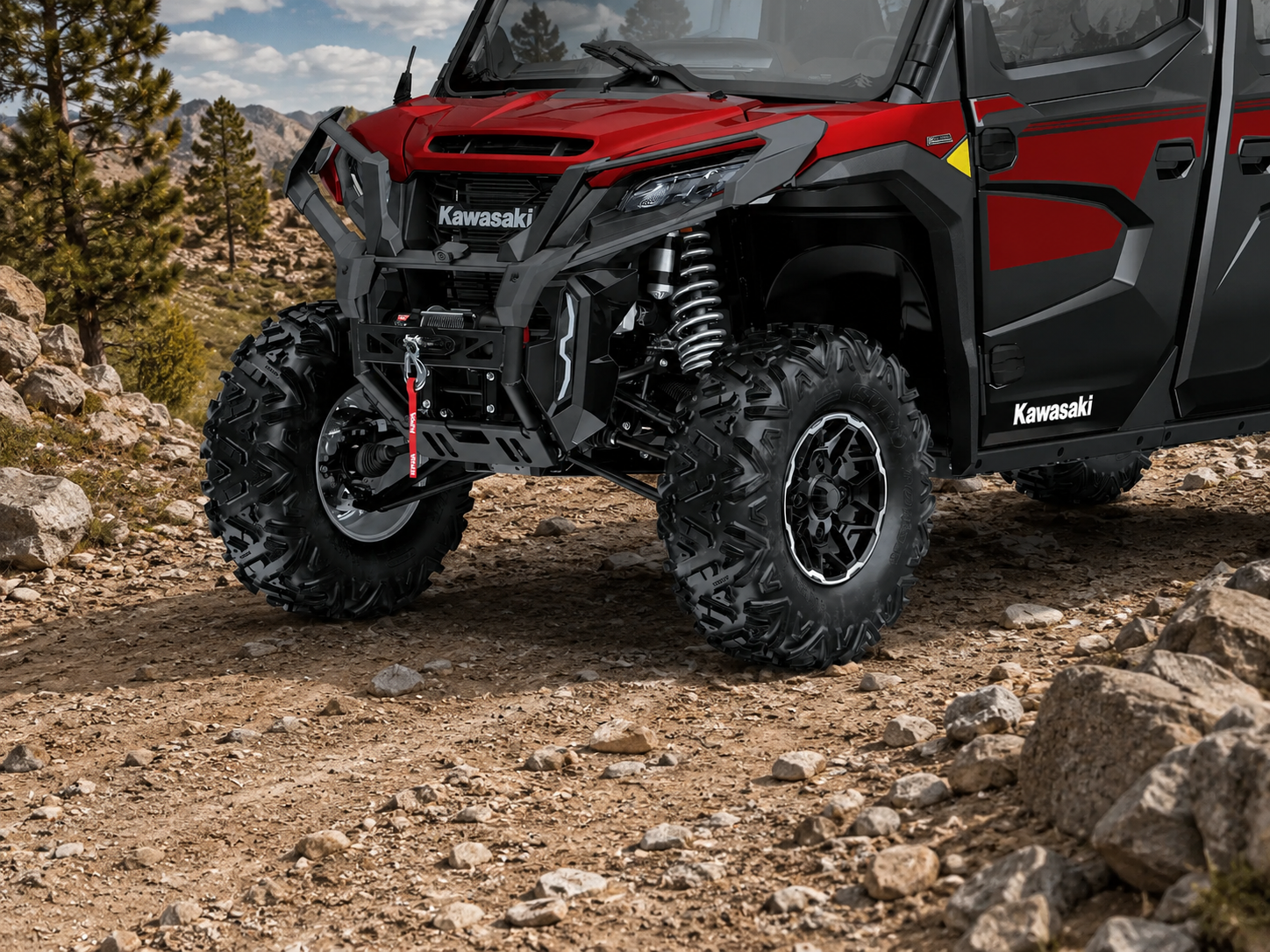
The factory front bumper is functional but light-duty. If you are adding a winch heavier than 4,500 lbs, plan on a replacement front bumper with an integrated winch mount and proper fairlead support. The Platinum Ranch Edition and XR Limited trims come with a factory WARN VRX 45-S installed, which uses a specific mounting plate that aftermarket bumpers need to accommodate or replace entirely.
For the rear, a bumper with receiver hitch reinforcement is worth it if you are towing near the 2,500-lb max. The factory hitch is rated to spec, but the surrounding sheet metal flexes more than UTV Source would like under sustained load.
Winch Selection
The Platinum Ranch Edition HVAC and XR Limited trims come with a WARN VRX 45-S Powersport Winch pre-installed from the factory. For other trims without a winch, this is your first major decision.
Sizing
Rule of thumb is 1.5x the curb weight as minimum pulling capacity. The Ridge sits roughly in the 2,000-lb range curb weight depending on trim, so the practical minimum is around 3,000 to 3,500 lbs of pull capacity.
UTV Source recommends 4,500 lbs as the practical minimum for the Ridge. Here is why:
- Winches pull at rated capacity only on the first wrap of the drum. Each additional wrap reduces pulling power by roughly 10 percent.
- Self-recovery from a stuck position with the machine loaded (passenger, cooler, gear) easily exceeds the first-layer capacity.
- Pulling another stuck machine doubles the load requirement.
For most Ridge owners, a 4,500-lb winch with synthetic rope is the sweet spot. If you frequently ride deep mud or pull trailers off-camber, step up to a 5,000-lb unit.
Synthetic vs. Steel Rope
Synthetic. Always synthetic on a UTV. It is lighter, safer if it snaps (no whip), and easier to handle in the field. Steel cable has its place on industrial equipment, but there is no reason for it on a Ridge. Yes, synthetic costs more and needs a UV cover, but you will thank yourself the first time you have to spool it back in by hand.
Browse the UTV Source winch selection for fitment options.
Wireless Remote
Get one. The factory wired remote works fine, but a wireless lets you stand clear of the line, see the rigging from the side, and avoid leaning over the hood. Most modern winches include both. If yours does not, it is a $50 to $80 add that pays for itself the first time you use it.
Tires and Wheels
The Ridge ships with 30-inch tires on 14-inch aluminum wheels across the lineup. The chassis has clearance for 31s with minor trimming or a small lift. Going bigger than 31 inches requires gear reduction or a major lift, and you will feel the impact on the CVT.
Tire Type by Use Case
- Trail and all-around: 8-ply radial in 30 to 31 inch. Look for tires under 45 lbs to keep unsprung weight reasonable.
- Mud: 30 to 31 inch aggressive lug. Expect noise, vibration, and reduced top speed.
- Hardpack and desert: Bias-ply or radial with closer lug spacing and reinforced sidewalls. 10-ply minimum on sharp rock.
- Work and property: Factory size with a heavier ply rating. Stock tires are fine for hauling and towing, but 6-ply gets cut easily on rougher property.
Browse the UTV Source tire and wheel selection for fitment.
Wheel Considerations
The Ridge uses a 4/156 bolt pattern with 12mm wheel studs. Most aftermarket UTV wheels in 14 and 15 inch fit. Things to check:
- Offset: Stock is around +10mm. Going more negative pushes the wheel out, widens the stance, but adds stress to the bearings and ball joints.
- Load rating: Cheap aluminum wheels are rated 1,200 lbs or less. With HVAC and a load, you want wheels rated 1,500 lbs minimum.
- Beadlock: Necessary only if you are airing down below 8 psi for rocks or sand. For most Ridge use cases, skip the cost and weight.
Suspension and Ride Quality
The Ridge's stock suspension is tuned for a balance of payload and ride. With 12.7 inches of front travel and 12.6 inches of rear, the platform actually has more travel than most competitors in the work-and-play segment. Where it falls apart is when you load the bed, add a passenger, and hit choppy terrain. The rear sags and the front gets light.
The new-for-2026 front stabilizer bar (standard on all trims except ST) addresses some of the body roll the launch-year Ridges showed at trail speed. If you are stepping up from a 2025, you will feel it.
Aftermarket Shocks
If you are running stock shocks and feeling beat up, you have two options:
- Rebuild and revalve: Send the factory shocks to a tuning shop. $400 to $600. Improves damping significantly but does not add travel.
- Aftermarket replacement: Full piggyback or remote-reservoir shocks from Fox, King, or Elka. $1,500 to $3,500 for a set. Major improvement but only worth it if you ride hard.
For most owners, a heavier rear spring rate is the cheapest fix. The Ridge's stock rear spring is undersprung for loaded use. A 10 to 15 percent stiffer rear spring transforms the ride when you are hauling.
Sway Bar and Anti-Roll
With the new 2026 front stabilizer bar standard on most trims, body roll is already better than the launch-year machines. If you are running a lift or oversized tires, you will still notice more body roll than stock. An adjustable sway bar end link kit ($150 to $250) lets you tune in or out depending on terrain. Mud and rocks benefit from disconnect kits. On-road and towing benefit from stiffer settings.
Lift Kits
UTV Source is generally not a fan of UTV lift kits beyond 2 inches. The Ridge is no exception. The CV angles, prop shaft angles, and steering geometry are designed around stock ride height. A 2-inch lift with matching upper A-arms or extended trailing arms is the practical maximum without driveline modifications.
If you want bigger tires, go with 31s on stock suspension or move up with a 2-inch lift. Anything beyond that is a project, not a quick build.
Lighting
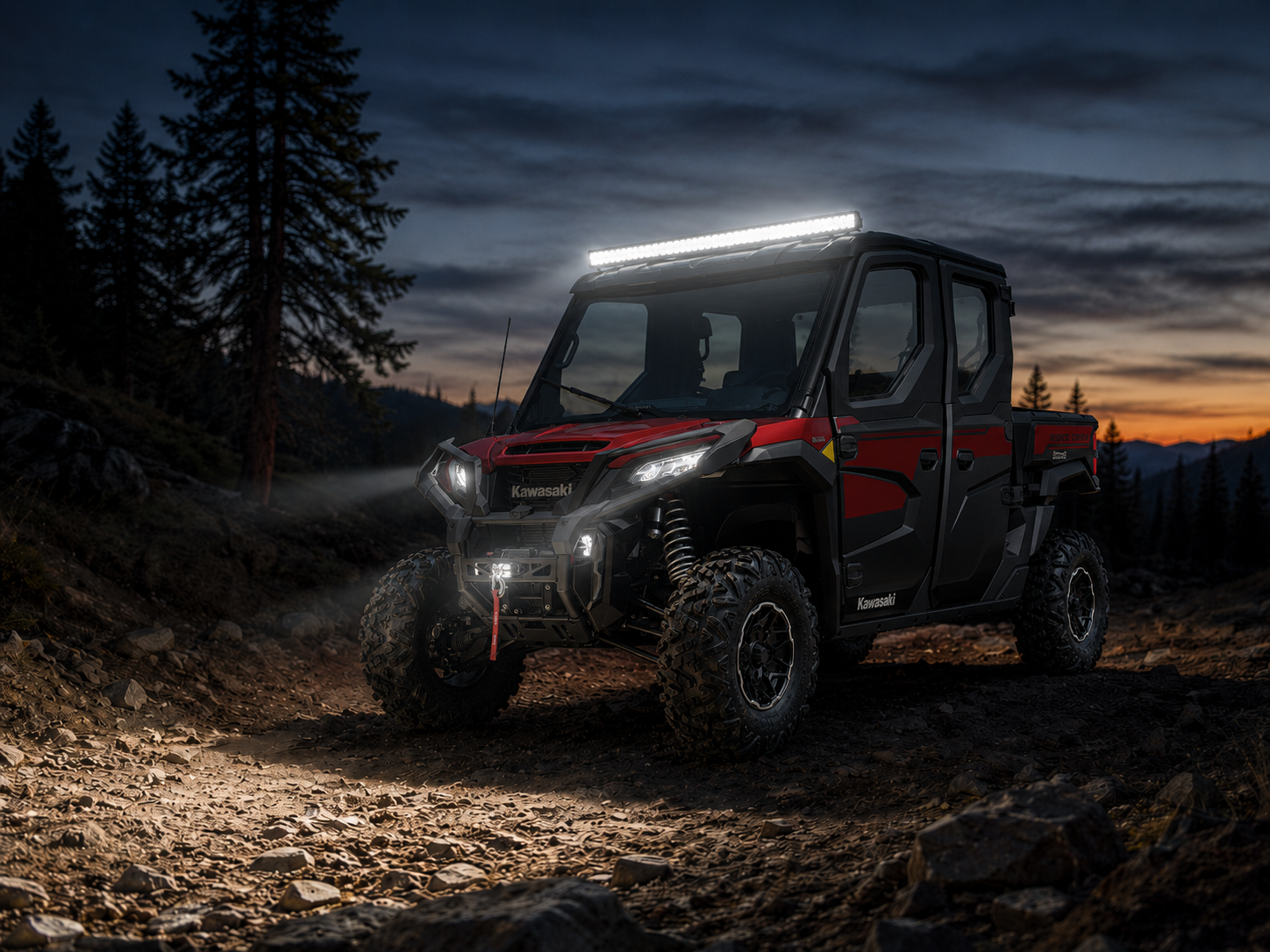
Stock Ridge headlights are LED on all trims, which is a win. Most factory UTV lighting is junk. But the beam pattern is optimized for slow trail use, not anything past about 25 mph. If you ride at night, you need more.
Light Bar Selection
The Ridge's roof crossbar and front cage tube accommodate light bars up to about 40 inches. Realistic options:
- 30-inch combo bar (spot and flood): The right answer for most riders. Mounts cleanly on the roof, throws enough light for trail riding at speed.
- 40-inch spot bar: Overkill unless you are running open desert or fields at night.
- 20-inch lower bumper bar: Useful as a supplement for close-in light. Does not blind oncoming traffic.
Wattage matters less than optics. A well-designed 120W combo bar will out-throw a cheap 240W flood every time.
Rock Lights and Accent Lighting
RGB rock lights (under the chassis, in the wheel wells, or under the dash) are useful for night work and camp setup. Get a quality kit with weatherproof connections and a controller that does not drain the battery. Cheap RGB kits are the number one source of parasitic battery drain on aftermarket UTVs.
Backup and Cube Lights
A pair of 3-inch cube lights mounted to the rear cage gives you backup illumination and worksite lighting for camp or repairs. Wire them through a switched circuit so they only run when you want them. With the rearview camera now standard on most 2026 trims, you have decent rear visibility from the cab, but real light still beats a screen for working at night.
Browse the UTV Source lighting selection for full options.
Audio Systems
The 2026 Ridge ships with a 7-inch full-color TFT display that handles vehicle info, drive modes, and (on non-ST trims) the rearview camera feed. The factory display is not a head unit for audio. If you want music, you are still adding an aftermarket system.
Head Unit Options
Three approaches:
- Bluetooth amplified controller: Smallest footprint, no display. Stream from your phone. Good for minimalist builds. $150 to $300.
- Marine head unit: Traditional radio look. AM/FM, Bluetooth, sometimes weather band. $200 to $400.
- Apple CarPlay/Android Auto display unit: 7 to 10-inch screen with full navigation and app support. $400 to $800. Just note that mounting one alongside the factory TFT means real estate planning.
For most riders, the Bluetooth amplified controller is the practical choice. You already have a phone with GPS and you already have the factory TFT. Adding a third screen is busy.
Speakers and Subs
Overhead pod speakers in 6.5-inch are the standard. A pair of 6.5s with a 200W amp will give you usable volume at trail speeds. If you want it loud enough to overcome wind noise at 50 mph, you need either tower speakers or horn-loaded compression drivers.
A subwoofer is optional. If you add one, mount it under the dash or behind the seats in a sealed enclosure. Ported enclosures do not survive UTV vibration long-term.
Browse the UTV Source audio and electronics selection for components.
Cab Comfort and Enclosure
Every 2026 Ridge ships as an HVAC trim with doors, full glass windshield, and climate control standard. That removes a lot of the cab buildout decisions Ridge owners faced in earlier model years. Where you still have room to spend:
Windshield Options
The factory glass windshield is durable and runs a wiper. If you want a different look or a vent option, aftermarket choices include hard-coated polycarbonate (lighter than glass, scratches over time) and folding or half windshields (useful for warm weather, compromise on weather protection). Most owners keep the factory glass and call it good.
Doors
The factory doors are excellent on the 2026 Ridge. If you are looking to add features (lower door inserts, push-button latches, sliding glass conversions), the aftermarket has options. Just verify fitment against your specific trim, since door geometry varies across the lineup.
Roof and Sound Deadening
The factory roof and the new 2026 sound-dampening rubber sheeting cut cabin noise significantly versus launch-year Ridges. If you want to go further, aftermarket roof options include composite roofs with additional sound deadening and fiberglass roofs with integrated lighting and audio prep for cleaner installs.
Cargo and Storage
The Ridge's tilt bed is one of its best features. Do not compromise it with cheap accessories that prevent tilting.
Bed Accessories
- Bed liner: Spray-in or drop-in. Spray-in is more durable but harder to remove. Drop-in catches debris underneath if you are not careful.
- Cargo rack: Tubular rack that bolts to bed sides. Useful for fuel cans, spare tire, gear. Verify it does not prevent bed tilt.
- Bed extender: Tailgate-mounted extender for hauling longer materials. Removes for tilt operation.
Cab Storage
The Ridge has a decent factory glovebox and underseat storage but no overhead. Aftermarket options:
- Overhead storage bags (mesh or zippered) mounted to the roll cage
- Center console organizers
- Door pockets
- Roof racks for long gear (fishing rods, hunting gear)
Drivetrain and Performance
The 999cc inline-four is solid from the factory. Kawasaki revised the CVT ratios for 2026 and added the idle collar bar (on all trims except ST) for quicker throttle response and less belt flutter. The aftermarket for engine performance is still developing since the platform is new, but a few areas are worth considering:
CVT Clutch Kits
If you add weight (tires, accessories, cargo) you will lose belt life and low-end response. A clutch kit with revised weights and springs tuned for your specific setup recovers the lost performance. Budget $300 to $500 for parts plus installation labor if you do not do it yourself.
Heavy-Duty Belt
The factory belt is rated for stock conditions. Heavy hauling, mud, or oversized tires will shorten its life. A heavy-duty aftermarket belt costs about $40 more than OEM and lasts noticeably longer under stress. Always carry a spare belt and the tools to change it.
Air Intake
The Ridge's intake is high-mounted, which is good for water crossings but limited for high-flow modifications. A snorkel kit raises the intake and CVT vent higher, useful for serious mud or water riding. Do not bother with a high-flow filter alone. You will not see meaningful gains without ECU tuning.
Recovery and Trail Essentials
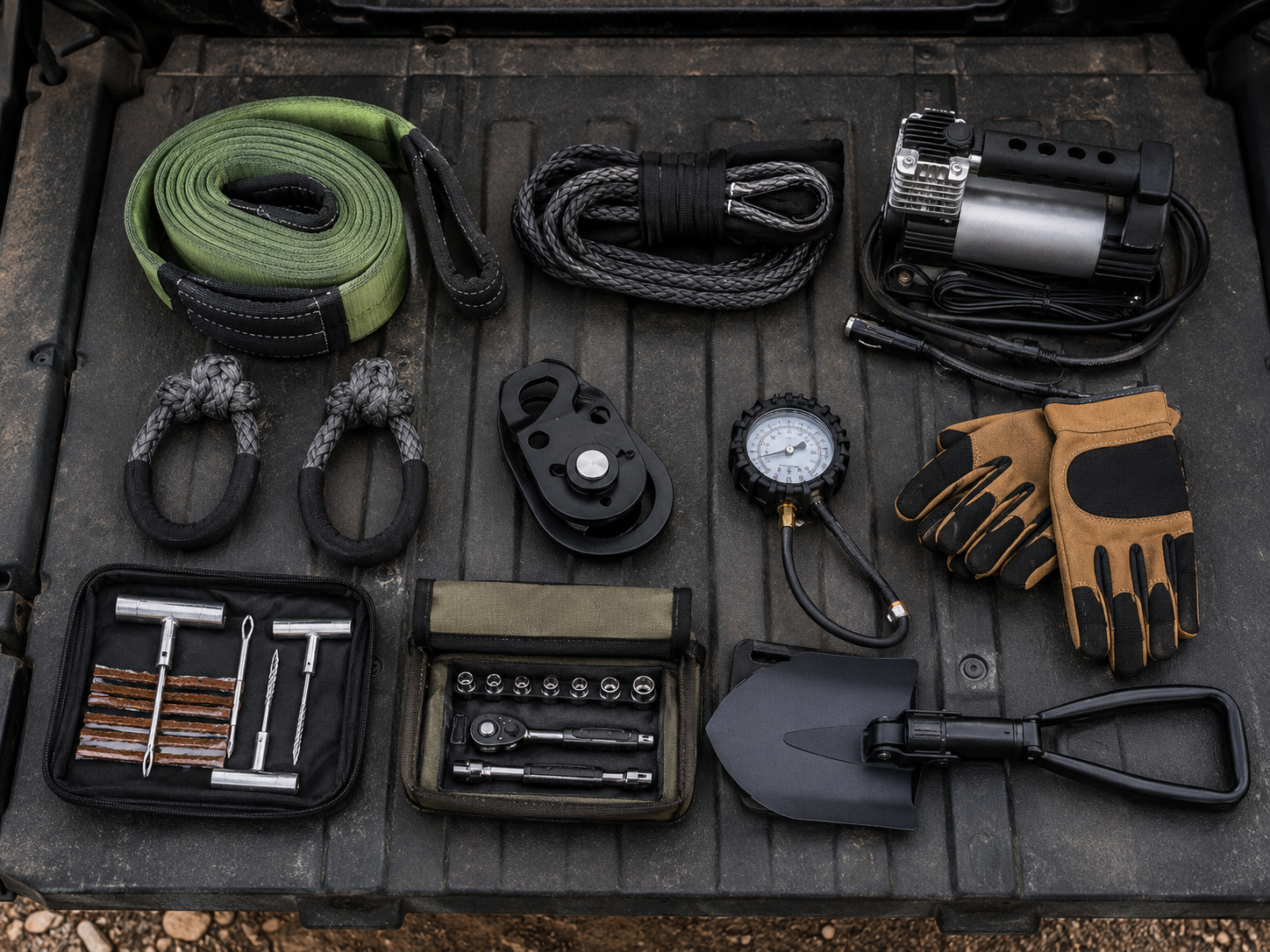
Even with a winch, you need recovery gear in the bed. Minimum loadout:
- 20-foot tree saver strap (3-inch wide, 30,000-lb rating)
- Soft shackle (rated 30,000+ lbs), safer than steel D-rings
- Snatch block or pulley for line redirection and doubling pull capacity
- Recovery gloves
- Folding shovel
- Tire repair plug kit and 12V air compressor
- Tow strap with looped ends (no metal hooks)
Add a basic tool roll: T-handle Allen and Torx, 1/2-inch breaker bar, socket set for axle nuts, and a tire pressure gauge.
Build Sequence: What to Buy First
If you are starting from a stock Ridge and have a finite budget, here is the order UTV Source would spend in:
- Full skid plate. Protects the most expensive parts of the machine.
- Winch (if not a Platinum Ranch Edition or XR Limited). Self-recovery capability.
- Recovery gear. Straps, shackles, gloves. Cheap and essential.
- Rock sliders. Protects the cab and gives you a step.
- Tires (if stock 30s do not fit your terrain). Biggest single performance gain.
- Lighting. Only if you ride at night.
- Audio. Quality of life.
- Suspension. Last because it is the most expensive and the stock setup is acceptable, especially with the new 2026 stabilizer bar.
Frequently Asked Questions
Does the Polaris or Can-Am aftermarket fit the Kawasaki Ridge?
No. The Ridge is a Kawasaki platform with its own chassis, mounting points, and dimensions. Some universal accessories (light bars, audio, recovery gear) work across brands, but anything that bolts to the chassis (skids, bumpers, sliders, doors) is Ridge-specific. Always verify fitment before ordering.
Will a 4,500-lb winch handle the heavier HVAC trims?
Yes. Even with HVAC and accessories, the Ridge sits in a curb weight range that a 4,500-lb winch handles for self-recovery. If you regularly pull other machines or operate in deep mud, step up to a 5,000-lb unit.
What is the biggest tire I can run without a lift?
The Ridge already ships on 30-inch tires. 31s fit on stock suspension with minor trimming or a 2-inch lift in most cases. Larger than 31 inches requires gear reduction to compensate for the changed final drive ratio and to protect the CVT belt.
What is the difference between the standard Ridge and the ST HVAC trim?
The ST HVAC is the entry-level trim. It runs a detuned version of the 999cc inline-four (92 hp, 65.4 lb-ft versus 116 hp, 73.8 lb-ft on the standard trims) and skips the front stabilizer bar, the idle collar bar, the rearview camera, and the updated CVT settings. If you want the full 2026 refresh feature set, look at Ridge HVAC and above.
Is the factory WARN winch on the XR Limited and Platinum Ranch Edition any good?
Yes. The VRX 45-S is a quality unit with synthetic rope. There is no reason to replace it unless you need higher capacity or want a specific feature (longer rope, different fairlead style). The factory installation is also clean and properly wired.
Do I need a roll cage replacement?
The factory cage on the Ridge meets safety standards and is adequate for utility use. If you are rock crawling, racing, or doing anything where a rollover is a real possibility, consider a reinforced or replacement cage. For trail riding, hunting, and work, the factory cage is fine. Just add quality 4-point harnesses to replace the factory belts if you ride aggressive terrain.
How is the 2026 Ridge different from the 2025?
The biggest changes are the new front stabilizer bar (all trims except ST), the idle collar bar on the primary pulley shaft for quicker throttle response, updated CVT ratios, added cabin sound dampening, the rearview camera on most trims, and revised driver ergonomics with a lower seat height. The chassis, engine displacement, and core dimensions carry over.
Final Thoughts
The 2026 Ridge is a capable platform out of the box, and the refresh closed most of the small gaps owners flagged on launch-year machines. Resist the urge to throw money at it before you have ridden it stock for a season. You will learn what actually needs work and what is fine. The aftermarket for this machine is still growing, so expect more options to appear through 2026 as the platform matures.
Focus your early spending on protection (skids, sliders), capability (winch, recovery), and the specific terrain you actually ride. Audio, lighting, and cosmetic additions can wait. A well-protected stock Ridge will outperform a heavily-modified one that is broken on the trail.