Polaris Xpedition: A UTV Source Build Guide for Exploring the Off Road Terrains from the Open Desert to Back Road Mountain Trails
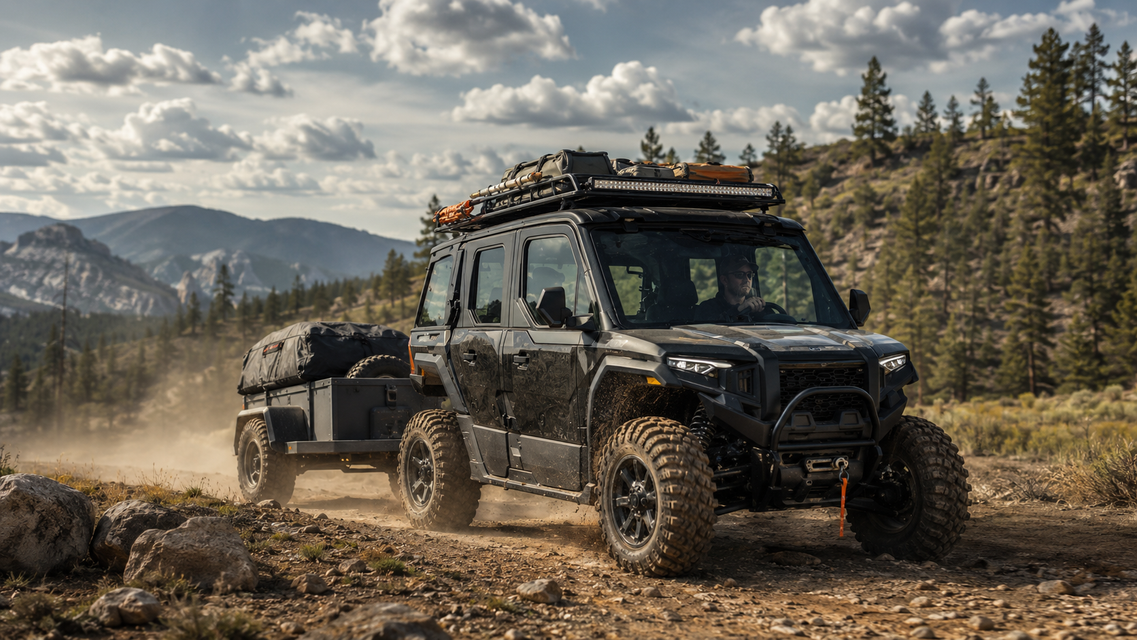
The Polaris Xpedition Build Guide: Hauling, Touring, and Doing It Right
The Polaris Xpedition is not a RZR, and it is not pretending to be one either. Polaris built this platform for a different kind of rider. The kind who wants to tow a 2,000-lb trailer to a remote campsite, haul firewood out of the back forty, or run a multi-day overland trip with the family and a full kit of gear. That changes how you think about accessories.
If you have come over from the RZR world, throw out the spec sheet you had memorized. Brake pad compounds, spring rates, rack capacities, and exhaust priorities all shift when you are routinely running at or near GVWR. This guide walks through what actually matters for an Xpedition built around hauling and touring use, not desert blasting.
Xpedition Platform Overview: Know What You Are Building On
For 2026, Polaris simplified the Xpedition lineup. Every 2026 Xpedition ships in NorthStar trim, which means a fully enclosed cab with HVAC, glass windshield, heat and air conditioning, and power windows are now standard across the lineup. The Premium and Ultimate trims that existed in 2024 and 2025 are gone for the 2026 model year.
What you do still pick between is configuration:
- Xpedition XP NorthStar (2-seat): The shorter platform with a 600-lb dumping cargo box. Closest thing to a traditional utility side-by-side in the lineup.
- Xpedition XP 5 NorthStar (5-seat): Longer wheelbase XP with rear seating and the dumping cargo box.
- Xpedition ADV NorthStar (2-seat): The 2-seat adventure configuration with an enclosed cargo back end for sealed gear storage.
- Xpedition ADV 5 NorthStar (5-seat): Long-wheelbase, 5-seat configuration aimed squarely at overland and family touring use.
Platform Specs to Keep in Mind
- Engine: 999cc ProStar 1000 Gen 2 twin-cylinder, 114 hp
- Towing capacity: 2,000 lbs
- Cargo box (XP and XP 5): 600 lbs dumping bed
- Payload capacity: Roughly 1,030 to 1,160 lbs depending on configuration
- Curb weight: ~2,500 lbs for the 2-seat XP NorthStar, climbing to ~2,913 lbs for the ADV 5 NorthStar
- Ground clearance: 14 in
- Suspension travel: 14 in front, 15 in rear, with FOX 2.0 Podium QS3 front shocks and FOX 2.5 Podium QS3 rear shocks
- Width: 64 in
- Fuel tank: 12.5 gallon
- Standard equipment: 4,500-lb Polaris HD winch, front bull bumper, ProFit Sport Roof, JBL Trail Pro 4100 audio, RIDE COMMAND+, 7-inch touchscreen, rearview camera
Why does this matter? Because every accessory recommendation in this guide assumes you know your starting weight. An ADV 5 NorthStar with four passengers, a full bed, and a loaded trailer is operating in a very different regime than a stripped 2-seat XP. The ADV 5 is also a heavy machine at nearly 3,000 lbs curb weight before you add a single thing to it. That weight changes how you think about brakes, suspension, and recovery gear.
Brake Components for Heavy Hauling
This is where most Xpedition owners start, and for good reason. The factory brakes are sized for the machine empty, not the machine with 1,200 lbs of gear and a 2,000-lb trailer behind it descending a forest service road grade. On a 2,913-lb ADV 5 loaded near payload capacity with a trailer in tow, the brake system is doing real work.
Why the Stock Setup Fades
Stock pads use an organic-leaning compound that is fine for occasional use but glazes quickly under sustained heat. When you are engine-braking down a long descent and feathering the brakes to keep the trailer in check, rotor temps climb past the pad's effective range. Pedal feel goes soft, stopping distance grows, and in worst cases you will cook the fluid and lose the pedal entirely.
What to Change
- Sintered or semi-metallic pads. These tolerate sustained heat far better than organic compounds. Expect more dust and slightly more rotor wear, but braking stays consistent.
- Slotted or drilled rotors. Slotting helps the pad outgas under heavy use and clears debris. Drilled rotors shed heat faster but can crack under abuse. For hauling use, slotted is the safer pick.
- Stainless braided lines. Stock rubber lines expand under pressure, which softens pedal feel as fluid heats up. Braided lines eliminate that flex.
- High-temp DOT 4 or DOT 5.1 fluid. Stock fluid has a dry boiling point around 401°F. A quality DOT 4 racing fluid pushes that to 500°F or higher. Flush annually if you tow regularly.
You can find Polaris Xpedition brake components sized specifically for the platform. Do not try to adapt RZR parts. Caliper mounting and rotor diameters are different.
Brake Bedding for Loaded Use
New pads need to be bedded properly, especially if you are going to load the machine immediately. Run 8 to 10 moderate stops from 30 mph down to 5 mph, then 2 to 3 harder stops from 45 mph, without coming to a complete stop between cycles. Let the brakes cool fully before loading or towing. Skip this and you will glaze the new pads on your first trailer descent.
Suspension for Loaded Offroad Adventures
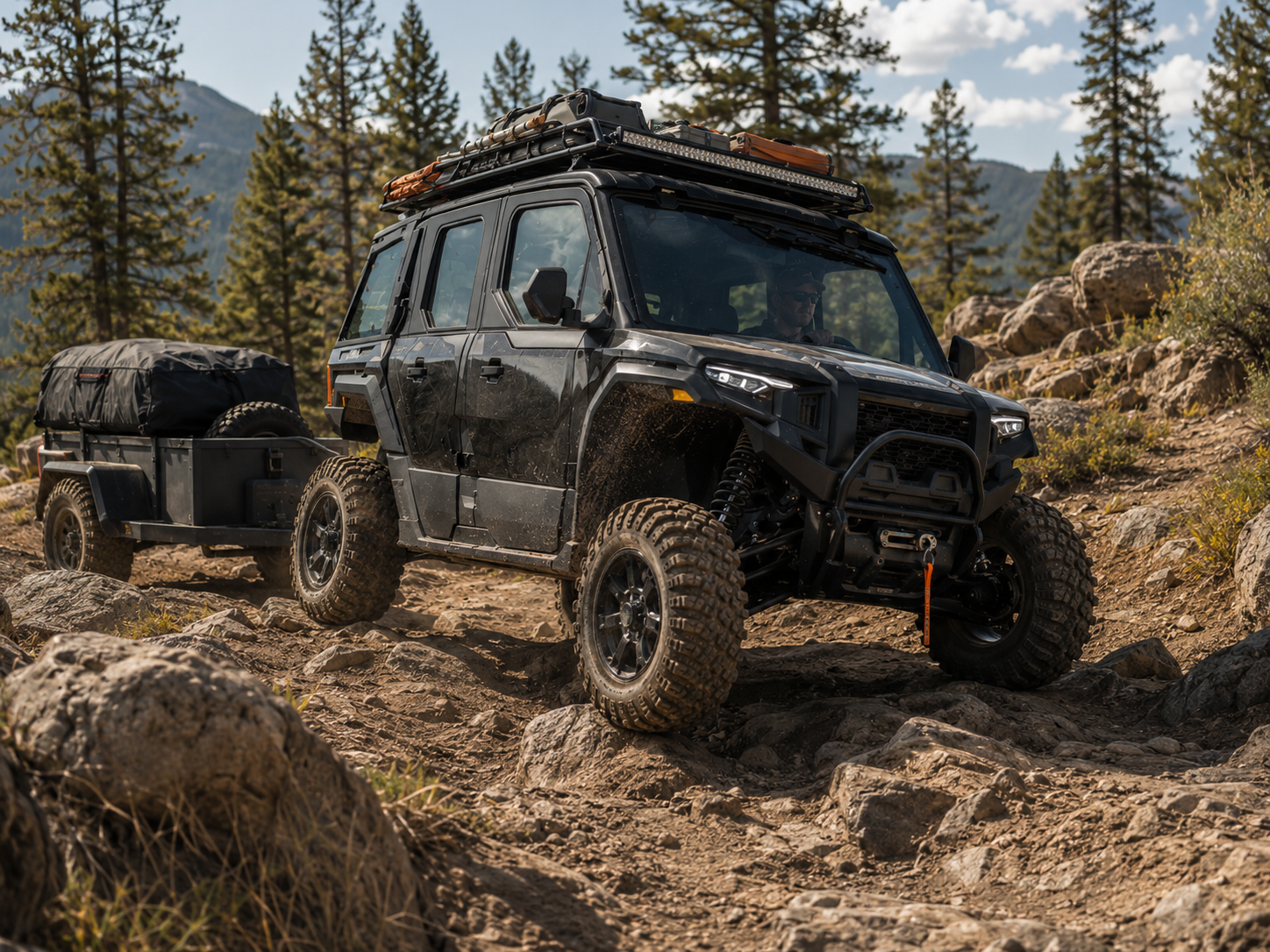
The Xpedition rides on long-travel independent suspension with 14 inches of front travel and 15 inches of rear travel, supported by FOX Podium QS3 shocks at all four corners. That is genuine long-travel hardware, and the QS3 adjustability gives you three damping settings on the fly. The problem is that the factory tune compromises between empty handling and moderate load capacity, and compromises do not excel at either end of the spectrum.
Spring Rate vs. Damping
When you load 800 lbs in the bed and attach a tongue-weight-heavy trailer, the rear of the Xpedition squats. Stock springs sag enough that you lose ground clearance, headlight aim points at the trees, and the rear shocks operate at the upper end of their travel where damping is least effective.
Two paths to fix this:
- Heavier rear springs. Direct fix for sag. You will lose a little ride compliance unloaded, but the machine sits level under load and the shocks operate in their designed range.
- Upgraded Shocks. Shocks that offer compression damping can help with the controlling the load and most are adjustable so you can increase ride height to compensate for additional weight
Sway Bar Considerations
The long-wheelbase ADV with a high-mounted cargo load develops more body roll than a stock RZR owner might expect. The Xpedition does come with factory stabilizer bars front and rear, but with a roof rack full of gear up top, a stiffer aftermarket rear sway bar reduces roll without harshening straight-line ride quality. If you are running cargo on the roof, and most overland builds do, the sway bar conversation becomes more important.
Tires Are Part of the Suspension
Do not ignore this. Stock tires on the Xpedition are an all-purpose compromise. For loaded touring, you want:
- An 8-ply or 10-ply rated tire with a stiffer sidewall. Resists rollover under load and survives sharp rocks better.
- A tread pattern weighted toward all-terrain rather than mud-specific. Mud tires wear fast on gravel forest roads and hum unbearably at 35 to 45 mph cruise speeds.
- A diameter close to stock unless you are regearing. Going from 30 inch to 32 inch tires on a loaded machine kills low-end acceleration and increases brake stopping distance noticeably. Worth remembering that the ADV 5 already weighs nearly 3,000 lbs empty.
Roof Rack and Storage Systems
The Xpedition's stock cargo bed handles a lot, but anyone serious about overland use needs vertical storage too. Roof racks open up sleeping gear, fuel cans, recovery boards, and spare tires. The good news is that the flat roof and Polaris's Lock & Ride MAX accessory system make outfitting the Xpedition straightforward compared to most platforms.
Rack Capacity Reality Check
Most quality UTV roof racks are rated for 100 to 150 lbs static load. That sounds like a lot until you start adding things up:
- Rooftop tent: 100 to 130 lbs
- Spare tire: 35 to 45 lbs
- Two 5-gallon fuel cans (full): 75 lbs
- Traction boards: 12 to 16 lbs
- Awning: 25 to 40 lbs
You can quickly exceed the static rating, and dynamic loads (washboard roads, hard hits) multiply that. If you are planning a rooftop tent build, look specifically for a rack rated for dynamic loads at the weight you intend to carry, not just the static spec.
Bed Storage and Cargo Management
The Xpedition's bed is the heart of its utility, but it is wasted space without organization. Consider:
- Tie-down rails or L-track. Far more versatile than the factory tie-down points. Lets you secure odd-shaped loads without ratchet straps flopping around.
- Locking storage boxes. Anything you would leave at a trailhead overnight needs to live in a locked box. Aluminum boxes hold up better than plastic for long-term outdoor exposure.
- Bed cover or cap. Weather protection becomes essential on multi-day trips. A soft cover is cheap and removes easily. A hard cap adds load capacity on top.
If you are running an ADV NorthStar with the enclosed back end, you already have sealed storage built in. That changes the bed conversation, but tie-down points and organization still matter.
Weight Distribution Principles
Heavy items go low and centered. Lighter, bulky items go up top. A common mistake is loading the rooftop tent and a full fuel rack, then putting more dense gear (tools, recovery gear, water) up high too. The result is a high center of gravity that makes the machine feel tippy on off-camber sections. Exactly where you do not want surprises with a family aboard.
Quiet Exhaust Options
This is where the Xpedition crowd diverges hard from the RZR crowd. Nobody touring with a family wants a louder exhaust. The factory exhaust is already louder than ideal for a 6-hour day in the cab, and with every 2026 Xpedition running the NorthStar enclosed cab, you hear more of the drivetrain than open-cab machines do.
What to Look For
Gibson Performance and similar quiet-exhaust manufacturers make exhausts that actually reduce decibel levels compared to stock while improving exhaust flow. Counterintuitive but real. Better internal geometry reduces backpressure without adding noise.
- Decibel rating below stock. Some manufacturers publish actual numbers. Verify they were measured at the operator's ear, not a 50-foot drive-by spec.
- Stainless construction. Aluminized exhausts rust through in 2 to 3 years of wet-trail use. Stainless lasts the life of the machine.
- USFS-approved spark arrestor. Critical if you ride in National Forest land. Non-compliant exhausts get tickets.
Cabin Noise Reduction Beyond the Exhaust
Since every 2026 Xpedition is a NorthStar with a fully enclosed cab, sound deadening makes a bigger cabin difference than the exhaust does. Self-adhesive butyl sound deadener on the firewall, floor pan, and rear bulkhead drops interior dB levels noticeably. Add a mass-loaded vinyl layer on top of that for high-frequency drone reduction.
Combined with a quiet exhaust, a properly deadened NorthStar cab is genuinely conversation-friendly at trail speeds.
Recovery Gear for ADV Trips
A RZR rider stuck on a play day has people nearby with winches. An Xpedition owner on day three of a backcountry trip might be 40 miles from the nearest road. Recovery gear becomes serious business.
Winch Sizing for the Xpedition
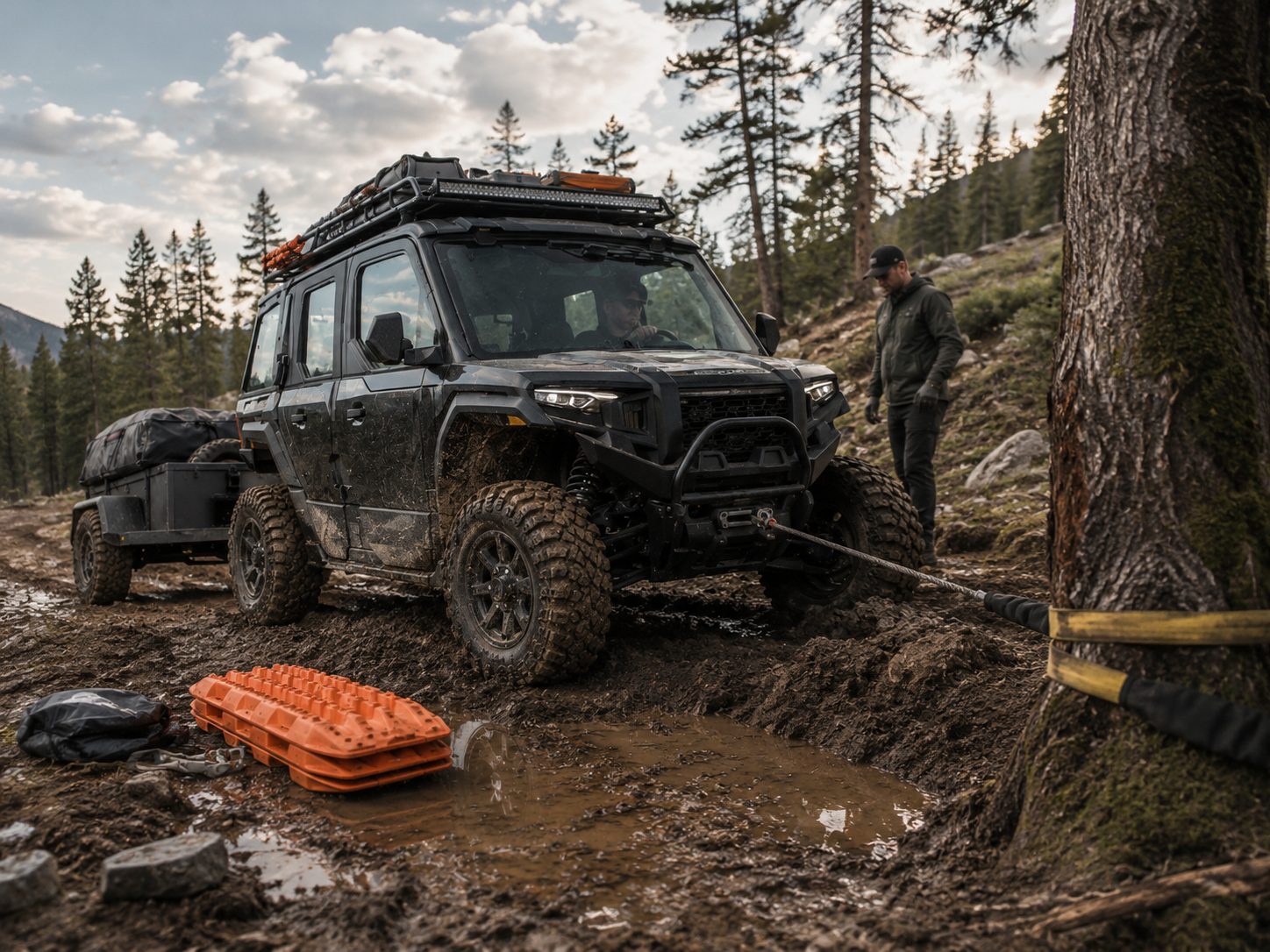
Every 2026 Xpedition ships with a factory-installed Polaris HD 4,500-lb winch. That is a reasonable starting point for the 2-seat XP, but it is the minimum for a loaded ADV 5 that can exceed 4,000 lbs with passengers and gear before you hook up a trailer. The general rule is winch capacity should be 1.5x the loaded weight of the vehicle.
- Xpedition XP loaded. The factory 4,500-lb winch is adequate for most scenarios, but 5,000 lbs is preferred if you frequently push capacity.
- Xpedition ADV 5 loaded with trailer. A 6,000-lb winch is realistic for self-recovery scenarios. The factory 4,500 will work for most stuck situations, but it has no margin for double-line pulls or trailer recoveries.
Synthetic rope is the standard now. It is lighter, does not store dangerous energy if it breaks, and is easier to handle. The downside is UV degradation and abrasion sensitivity. Inspect it every trip and replace it every few years regardless of visible condition. Browse the UTV Source UTV winch and recovery accessories for platform-specific options.
Recovery Kit Essentials
- Kinetic recovery rope (20 to 30 ft, rated for 2x vehicle weight)
- Two soft shackles (lighter and safer than steel)
- Tree saver strap (3 ft minimum)
- Snatch block or pulley (doubles winch capacity, changes pull direction)
- Heavy gloves (synthetic rope splinters are real)
- Traction boards (for sand, mud, snow self-recovery)
- Folding shovel
- Hi-lift or bottle jack with a wide base plate
Where to Mount It
Recovery gear weight should live low and rearward when possible. A heavy bumper-mounted winch is unavoidable, but the rest of the kit fits better in the bed or a locking storage box. Do not put 30 lbs of recovery gear on the roof rack. You have defeated the purpose of carrying it.
Lighting for Overland Use
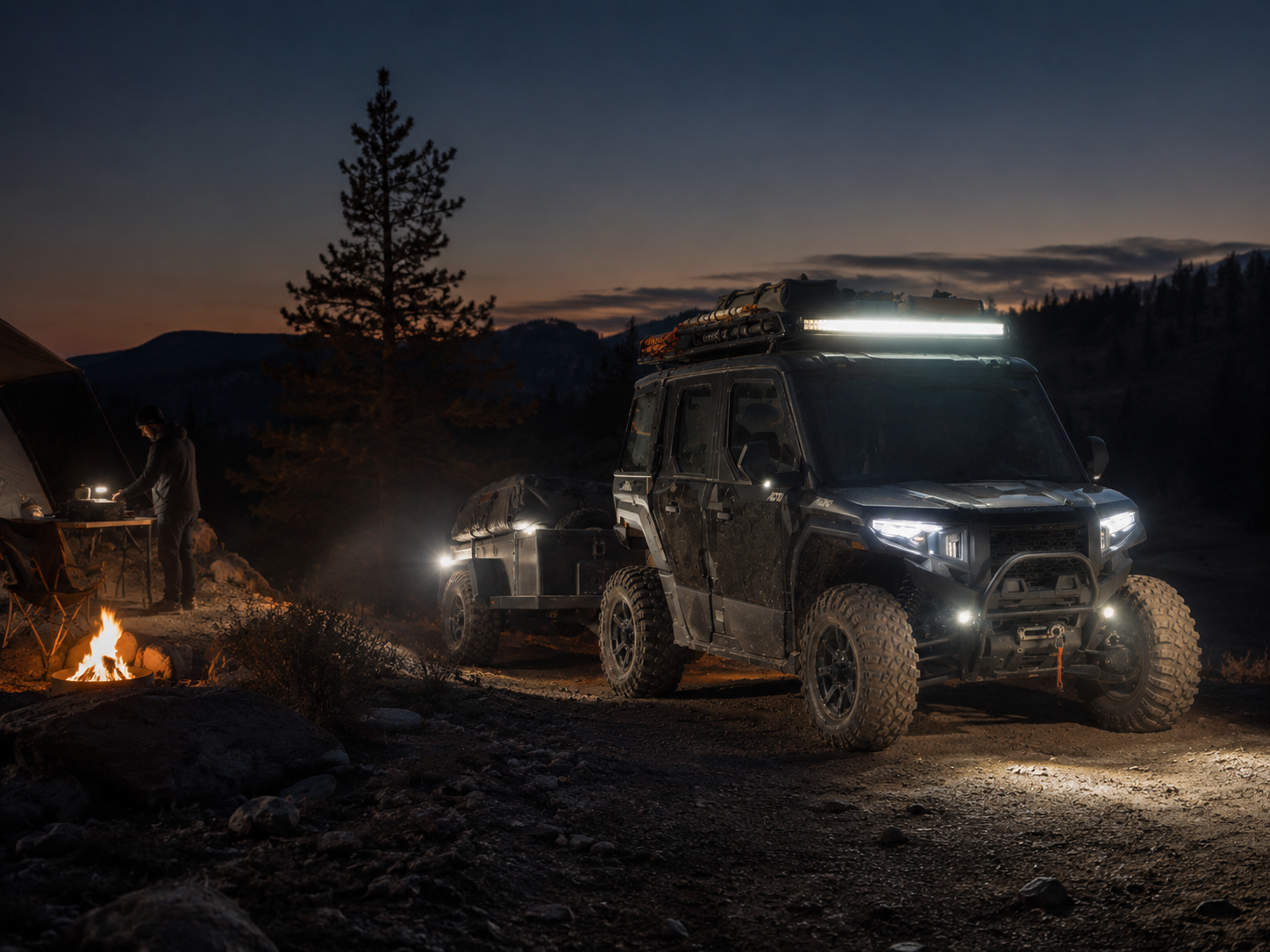
Stock Xpedition headlights are LED and adequate for trail speed in good conditions. They are not adequate for picking your way through unfamiliar two-track at night, scouting a campsite, or seeing a deer at 100 yards on a forest road.
Light Bar Selection
For overland use, you want a mix of beam patterns:
- Spot. Long, narrow throw. Good for high-speed sections and seeing far ahead. Useless for slow trail work because it lights up trees a quarter mile away while leaving the trail in front of you dark.
- Flood. Wide, short throw. Lights up the trail edges and immediate foreground. The right pattern for technical sections at 5 to 15 mph.
- Combo. Most light bars combine both. A 40 to 50 inch combo bar on the roof line covers most overland use cases.
Auxiliary and Work Lighting
Roof-mounted main lighting handles forward visibility. You also want:
- Rock lights or A-pillar pods. For seeing the ground immediately next to and under the machine. Critical for spotting a tire on an obstacle.
- Rear flood light. Reversing into a campsite at 11 PM with a trailer behind you is the moment you will regret skipping this. The factory rearview camera helps, but real light still beats a screen.
- Cab dome light (red and white). Red light preserves night vision when reading maps or finding gear inside the cab.
- Chase light or rear amber. Visibility for anyone behind you on dusty roads.
Browse the UTV Source UTV lighting options for the Xpedition platform. Pay attention to mounting hardware compatibility with the factory cage and roof.
Electrical Load Reality
The Xpedition's 140-amp alternator handles factory loads with margin, but a fully loaded lighting build (50 inch light bar, four pods, rock lights, work light, audio system) can exceed alternator capacity at idle. Symptoms include flickering lights when stopped, slow cranking after extended idle, and battery drain on long stops.
If you are building heavy, look into:
- A higher-output charging system if available for your model year
- A dual-battery setup with isolator, so accessory loads do not drain the starting battery
- Switched relays so non-essential loads cut out automatically below a voltage threshold
Putting the Build Together
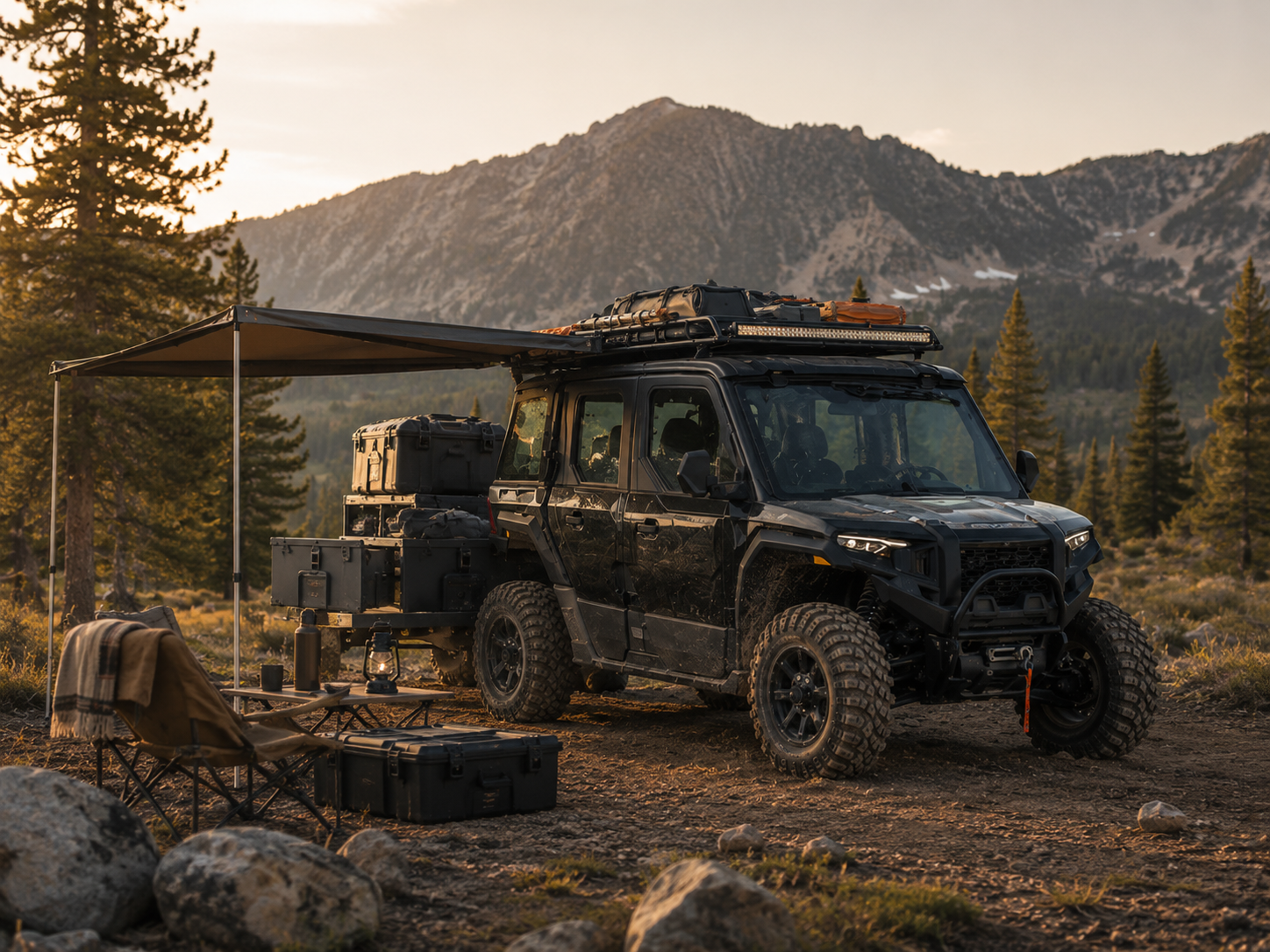
A solid Xpedition overland build does not happen in one weekend, and it should not. Each addition interacts with the others. Heavier rear springs change brake bias slightly. A loaded roof rack changes how the suspension behaves on off-camber. A bigger winch adds front weight that affects steering effort and front shock loading.
The order UTV Source recommends:
- Brakes first. You cannot safely test other changes under load with marginal brakes.
- Suspension second. Get the machine sitting and behaving correctly under your typical loaded weight.
- Tires concurrent with suspension. Spring rate and tire load rating need to match.
- Recovery and lighting third. Now you can venture further with confidence.
- Storage and racks fourth. Builds tend to evolve here as you learn what gear you actually use.
- Exhaust and sound deadening last. Quality-of-life additions after the functional stuff is dialed.
Skip steps and you will find yourself with a roof rack full of gear you cannot stop with, or a 5,000-lb winch on a machine whose rear suspension is already maxed out before you load the bed.
Frequently Asked Questions
Can I use Polaris RZR accessories on my Xpedition?
Some, but not most. The Xpedition shares some bolt patterns and electrical connectors with the RZR XP platform, but cage geometry, brake hardware, suspension mounting points, and bed dimensions are different. Always verify fitment against the specific configuration of your Xpedition (XP, XP 5, ADV, or ADV 5) before ordering.
What is the real towing limit on the Xpedition?
Polaris rates the Xpedition at 2,000 lbs trailer weight across the lineup. That is a structural and braking rating, not a recommendation for sustained mountain use. If you are towing in steep terrain or for long distances, treat the rating as a ceiling and load 25 to 30 percent under it. Improve the brakes and add a transmission cooler if you are going to live near the limit.
Do I need a transmission cooler if I tow regularly?
For occasional towing on flat terrain, no. For regular hauling in hot weather or on grades, yes. The CVT and transmission run hotter under sustained load, and heat is the primary killer of belts and clutches. An auxiliary cooler is cheap insurance.
How much weight can I really put on the roof rack?
Check the rack's static and dynamic ratings separately. Most quality racks are good for 100 to 150 lbs static (parked) but only 50 to 75 percent of that dynamically (in motion over rough terrain). A rooftop tent plus occupant during a campsite stay is a static load. A fuel can rack while bouncing down a forest road is dynamic. Do not exceed the dynamic spec.
Will a louder aftermarket exhaust hurt my warranty?
Exhaust replacement itself does not void your warranty under federal Magnuson-Moss law, but Polaris can deny warranty claims on related components if they can show the modification caused the failure. For an Xpedition meant for family touring, the noise tradeoff is not worth it anyway. Stick with quiet-style aftermarket exhausts if you change it at all.
What is the difference between the Xpedition XP and ADV configurations?
The XP has a 600-lb dumping cargo box at the rear, making it the more traditional utility configuration. The ADV swaps the dumping box for an enclosed sealed cargo area, which is better suited to overland gear storage and weather protection. Both come in 2-seat and 5-seat versions, and for 2026 both are offered only in NorthStar trim with the fully enclosed cab and HVAC.
What is the single best first thing to spend on for an Xpedition I plan to tow with?
Brake pads and stainless lines. They are the cheapest meaningful addition, have the biggest safety impact, and let you confidently test the towing capacity of the machine before committing to bigger spend on suspension or racks. Add high-temp brake fluid at the same time and bed everything in properly before your first loaded trip.
How heavy is the Xpedition really?
Heavier than it looks. The 2-seat XP NorthStar sits around 2,500 lbs curb weight. The ADV 5 NorthStar pushes 2,913 lbs before you put a single thing on it. Add four passengers, a full bed, a rooftop tent, and recovery gear, and you are easily into 4,000-plus-lb territory. That weight is part of why brakes, suspension springs, and tire ply rating matter so much on this platform.
Final Thoughts
The Polaris Xpedition fills a niche that Polaris had not really addressed before. The side-by-side as overland and utility platform rather than performance machine. That means the accessory market for it is still developing, and a lot of the conventional UTV build wisdom does not apply directly.
Build around your actual use case. If you are hauling firewood and running to hunting camp, you do not need a 50 inch combo light bar and a rooftop tent. If you are planning multi-state overland trips with the family, you need to think about every system (brakes, suspension, recovery, electrical) as part of an integrated package, not a list of individual accessories.
Measure your typical loaded weight before you start. Build in the order that protects safety first. And resist the temptation to copy a RZR build. This machine is a different animal, and it rewards being built like one.