Use-Case Picks · 2026

Best UTV
For The Dunes

Vehicle-by-vehicle picks plus the paddle tires, LED whips, flags, and dune-setup parts that turn any sport machine into a Glamis-ready build.

By the UTV Source product team Updated May 2026 Read time 12 min Coverage 6 sport platforms

The best UTVs for the dunes

Six sport machines own dune country in 2026. Each pick below is framed for dune use specifically — what makes it the right machine for sand, not generic vehicle praise.

Best Overall Dune Machine

Polaris RZR Pro R Ultimate

2022–2026 · Polaris · Naturally aspirated
  • Engine2.0L NA I-4
  • Output225 HP
  • Width74 in
  • Suspension travel29 in (R)
  • Bolt pattern5x114.3
  • Stock wheel15 in

The Pro R Ultimate sits at the top of the Polaris RZR lineup and it's the only naturally aspirated sport UTV that can lay down dune-drag numbers like a turbo. A 2.0-liter inline-four producing 225 horsepower lets the Pro R hold a clean throttle uphill at full chat — no heat-soak, no turbo bog, no clutch-belt anxiety. That matters in Glamis where elevation changes and 100-degree days cook turbocharged machines.

For dune duty the Pro R wears the unique Polaris 5x114.3 bolt pattern (different from every other RZR), so plan tire purchases around the dedicated 15-inch sand rim. The 29 inches of rear travel and 74-inch stance make it stable at speed on whoops; the GPS-style Dynamix DV suspension on the Ultimate package adapts ride height to dune transitions in real time.

One reality check: the Pro R is heavy by class standards (around 2,070 lb dry on the 4-seat), and you'll want a 14-paddle high-horsepower rear setup, not a 10-paddle. Pair that with a sand-tuned clutch and Glamis is fundamentally yours.

Dune Accessory Shortlist for the Pro R
Why it wins on sand
  • No turbo to heat-soak on long dune climbs
  • 225 HP naturally aspirated power comes on the moment you ask for it
  • 74-inch stance + 29 in rear travel = stable at speed in big whoops
  • Dynamix DV adapts damping across dune transitions
Trade-offs
  • Heaviest sport RZR by ~150 lb — needs 14-paddle, not 10-paddle
  • 5x114.3 bolt pattern doesn't share rims with other Polaris models
  • Premium pricing on the Ultimate trim ($40K+ MSRP)
  • Big-bore cooling needs clean airflow — do not skip the prefilter
Premium / Halo Build

Can-Am Maverick R

2024–2026 · Can-Am · Turbocharged with 7-speed DCT
  • Engine999cc Turbo
  • Output240 HP
  • Transmission7-speed DCT
  • Width77 in
  • Travel (R)26 in
  • Bolt pattern6x139.7 (industry-first)

Can-Am rewrote the sport UTV formula with the Maverick R. A 240-horsepower turbocharged 999cc triple paired with a 7-speed dual-clutch transmission (the first of its kind in the segment) means no CVT belt to burn in deep sand — the gearbox does the work the way a sportbike or supercar does it. For dune buyers who've worn through a stack of CVT belts on previous machines, this alone is the headline.

The catch: Can-Am's industry-first 6x139.7 bolt pattern doesn't share with anything else. Maverick R rims are dedicated stock. That means the dune paddle catalog is still maturing (more SKUs every quarter) and you cannot run X3 sand tires on a Maverick R. Plan early, order specific.

On the sand the Maverick R is fast, predictable, and tuned to keep traction in the variable boost range that used to cause issues on early turbo machines. The 7-speed DCT lets it pull from low gears up tall dune faces without backing off. Premium build, premium price.

Dune Accessory Shortlist for the Maverick R
Why it wins on sand
  • 240 HP turbo with class-leading 7-speed DCT — no CVT belt to fail
  • Pull tall dune faces in 2nd or 3rd gear without losing torque
  • 77-inch stance is the widest sport platform in the segment
  • Newest sport UTV chassis — cutting-edge geometry for high-speed work
Trade-offs
  • 6x139.7 bolt pattern — zero cross-fit with X3, Pro R, or any other UTV
  • Paddle catalog still maturing — fewer SKU options than X3
  • Premium MSRP ($45K+) is the highest in the sport class
  • Newer platform means less seat-time knowledge from the dune crowd
Best Premium Turbo

Polaris RZR Turbo R

2022–2026 · Polaris · Turbocharged
  • Engine925cc Turbo
  • Output181 HP
  • Width74 in
  • Travel (R)27 in
  • Bolt pattern4x156
  • Stock wheel15 in

The Turbo R is what the Pro R's buyers passed over to chase NA reliability — but it's the right machine for dune buyers who want turbo torque on a more familiar Polaris architecture. 181 horsepower on the stock tune (more with a kit) and FOX Live Valve suspension that reacts to terrain in milliseconds makes the Turbo R immensely capable in the dunes.

It shares the more common 4x156 bolt pattern with the Pro XP — so the paddle and wheel catalog is deeper than the Pro R's. Boost can be the variable that hurts you on a 110-degree Glamis afternoon; a quality air filter and heat-management plan are non-negotiable.

For buyers who already have a Polaris dealer relationship and want the Pro R chassis without the price, the Turbo R is the move.

Dune Accessory Shortlist for the Turbo R
Why it wins on sand
  • FOX Live Valve damping reacts faster than driver inputs can
  • 4x156 bolt pattern shares with Pro XP — biggest paddle catalog of any Polaris
  • 74-inch stance and 27 inches rear travel handle big-whoop sections
  • Cheaper than Pro R, faster than Pro XP — the sweet spot for many buyers
Trade-offs
  • Turbo heat-soak risk on long, hot Glamis weekends
  • CVT belt management — not a DCT
  • Less seat-time legacy than the older XP Turbo
Deepest Aftermarket / Best Value Sport

Can-Am Maverick X3 X RS Turbo RR

2017–2026 · Can-Am · Turbocharged
  • Engine900cc Turbo
  • Output200 HP
  • Width72–77 in
  • Travel (R)24 in
  • Bolt pattern4x137
  • Stock wheel14 / 15 in

The X3 has been the dune crowd's default sport UTV for nearly a decade, and the X RS Turbo RR is its high-water mark — 200 horsepower from a 900cc turbo triple, with a 72- to 77-inch stance depending on package and a chassis the aftermarket has had years to optimize. If you want the deepest catalog of paddle tires, sand-tuned clutch kits, intake snorkels, and dune-specific armor — this is your platform.

The 4x137 bolt pattern is shared with the Defender and Pioneer (Can-Am+Honda utility crossover), giving the X3 the broadest wheel-and-tire compatibility of any sport UTV. Pair that with the largest CVT belt and clutch tuning ecosystem in UTV (every major shop offers an X3 sand-tune kit) and you get a platform that's easy to dial in.

The X3 is also the only sport UTV with a meaningful budget-tune path: paddles + clutch kit + whips for ~$2K total, riding immediately better. That's why it's still the most-recommended dune sport UTV in 2026.

Dune Accessory Shortlist for the X3
Why it wins on sand
  • Deepest aftermarket of any sport UTV — every brand makes X3 parts
  • 4x137 bolt pattern shared with Defender and Pioneer = broad wheel options
  • Mature clutch + belt ecosystem; every shop tunes X3 for sand
  • Best $/HP in the sport segment with the X RS Turbo RR
Trade-offs
  • Older chassis design than the Maverick R or Pro R
  • Boost heat is the X3's historical weak spot — intercooler upgrades exist for a reason
  • 24 inches rear travel falls short of the Pro R's 29 in
Proven Turbo Sport

Polaris RZR Pro XP Ultimate

2020–2026 · Polaris · Turbocharged
  • Engine925cc Turbo
  • Output181 HP
  • Width72 in
  • Travel (R)20 in
  • Bolt pattern4x156
  • Stock wheel14 / 15 in

The Pro XP is the mature Polaris sport UTV that the Pro R replaced at the top of the lineup — but it's still wildly capable on dunes and the resale market on used Pro XPs is friendly. Same turbo as the Turbo R (181 horsepower stock) on a narrower 72-inch stance, with 20 inches of rear travel that's plenty for most riders.

What makes the Pro XP a great dune buy in 2026 is the parts depth. 4x156 bolt pattern, six years of aftermarket development, every major clutch shop has an XP tune, and the wheel catalog is enormous. If you're looking for a sport machine to grow into without the Pro R Ultimate price tag, the Pro XP is the most-overlooked value in the dune class.

Dune Accessory Shortlist for the Pro XP
Why it wins on sand
  • Used Pro XP market makes this the cheapest 181hp turbo sport platform
  • 4x156 bolt pattern shares wheels with the Turbo R
  • Most-tuned platform in Polaris's catalog for the dune crowd
  • 72-inch narrower stance is easier to navigate tight dune passes
Trade-offs
  • Only 20 inches of rear travel vs. 27 / 29 on Turbo R / Pro R
  • Same turbo heat-soak risk as the Turbo R
  • Being phased out of new-production focus — some 2026 trims discontinued
Best for the Budget

Kawasaki Teryx KRX 1000

2020–2026 · Kawasaki · Naturally aspirated
  • Engine999cc NA twin
  • Output112 HP
  • Width68.1 in
  • Travel (R)21.1 in
  • Bolt pattern4x137
  • Stock wheel15 in

For dune buyers stretching the budget, the Kawasaki KRX 1000 is the surprise pick. 112 horsepower naturally aspirated will not chase down a Maverick R, but for casual Glamis or Dumont riding it has plenty of grunt — and it's built like a tank. The narrower 68-inch stance plays well in tight, technical dune sections.

The KRX's 4x137 bolt pattern (shared with Honda Talon and Can-Am Defender) means you've got real options for sand paddles — not as deep as the X3 catalog but workable. Where the KRX shines is build quality; Kawasaki's reputation for reliability is well-earned and the dune-temperature engine compartment is forgiving for a naturally aspirated machine.

If you're a once-a-year dune rider who also uses the machine for trail or hunting work, the KRX is the smart play. Buy it, throw paddles + whips + a flag on it, and you're in business.

Dune Accessory Shortlist for the KRX
Why it wins on sand
  • Cheapest entry into capable dune sport-utility class
  • Naturally aspirated reliability — no turbo heat-soak
  • 4x137 bolt pattern = real paddle tire options
  • Doubles as a trail / hunting / utility machine when not at the dunes
Trade-offs
  • 112 HP is not class-competitive against turbo sport UTVs in straight-line dune drag
  • Narrower stance and shorter travel limit you in big-whoop terrain
  • 21 in rear travel is fine for casual dunes, not for race-pace work

Also dune-capable but not deep-dived here: the Polaris RZR XP 1000 (the OG dune sport UTV, still in catalogs and parts everywhere), the Yamaha YXZ1000R (the only paddle-shift-gearbox sport UTV besides the Maverick R), and the Honda Talon 1000R (dual-clutch reliability with Honda's parts-cost advantage). All three have committed dune followings — just smaller aftermarket dune-tune ecosystems than the picks above.

What every dune build needs

Eight accessory categories that turn a stock sport UTV into a dune-capable machine. Each category links to our deep buyer's guide for that part — this is the dune-specific summary.

1. Paddle Tires (Mandatory)

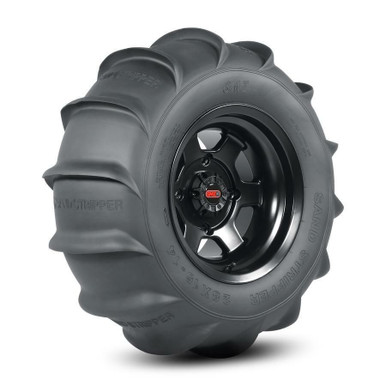
Stock all-terrain tires float on hard pack but bog down in deep sand. Paddle tires use 8–16 vertical cleats per tire to push sand backward and propel forward. Front tires are usually smooth-ribbed or have a 3D diamond pattern for steering. Paddle count matters: 10 paddles for naturally aspirated machines, 14–16 for turbo and big-bore.

2. LED Whips (Required at Glamis)

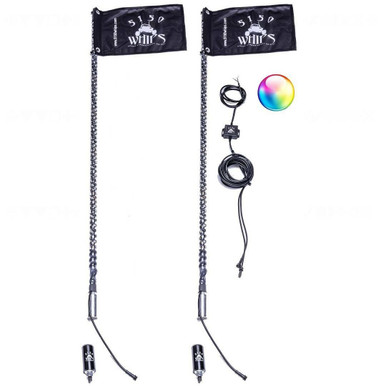
BLM regulations at Imperial Sand Dunes Recreation Area require an 8-foot mast extending from the ground to the tip of the whip on every off-highway vehicle, day and night. LED whips serve double duty: meeting the mast-height requirement and making your machine visible from the next dune over. Pair-mounted whips are standard.

3. Whip Flag (BLM-Compliant)

The BLM requires a 6x12 inch red or orange flag attached at the whip mast tip in addition to the mast itself. Flag colors are visibility-coded: solar orange is the strongest dune-distance daytime color. Pennant, triangle, square, or rectangular shapes are all acceptable. Quad-stitched, light-blocking 250g material survives a season of sun and sand.

4. Sand-Tuned Clutch Kit

Paddle tires dramatically change the load profile on a CVT clutch and belt. Without re-springing and re-weighting the primary and secondary, you'll burn through drive belts on a single weekend at Glamis. A sand-tune clutch kit (with appropriate primary spring rate and clutch weights for your altitude and paddle count) is the difference between a fun ride and a recovery rope.

EPI Performance, EVO Powersports, Aftermarket Assassins
$249–$549 typical kit price
Browse clutch kits by model

5. Air Filter / Particle Separator

Sand and dust kill UTV engines faster than any other ride condition. A high-efficiency air filter or, for turbo machines, a S&B Particle Separator that ejects 94% of dust before it ever reaches the airbox, is non-negotiable in the dunes. Plan to clean the filter after every weekend — sand contamination compounds quickly.

S&B Particle Separator (X3 / Pro XP), DynoJet R2C Extreme
$75–$499 depending on platform
Shop air filters

6. LED Light Bar (Night Dune Runs)

Dune riding goes well past sunset. Stock UTV headlights are designed for trail driving; they wash out the contrast you need to read dune shadows at speed. A 30–42 inch LED light bar mounted on the roof or front bumper transforms night dune work — pair with rear chase lights to be seen from behind.

KC HiLites, Rigid Industries, Heretic Studio · LED bars + rear chase
$199–$999 bar + harness
Shop light bars

7. Skid Plate

Dunes hide rocks. The Imperial Sand Dunes sit on a desert basin floor and ironwood, mesquite roots, and the occasional buried truck part wait to crack your engine cases. A 1/2-inch UHMW or aluminum full skid plate is cheap insurance — UHMW shrugs off sand contact and slides over obstacles, aluminum dents and protects.

SuperATV ARMW (1/2 in UHMW), Tusk Quiet-Glide (3/8 in UHMW)
$559–$1029 platform-specific full skid
Shop skid plates

8. Comms + Helmet Intercom

Dunes are loud. Wind, engine, paddles throwing sand — you cannot have a conversation at speed without intercom helmets. PCI and Rugged Radios are the dominant ecosystems; both run wired helmet kits with handheld radios. Critical for group riding and locating a stuck partner across a dune valley.

PCI Race Radios, Rugged Radios, Kenwood + handheld
$299–$999 helmet kits + radio
Shop helmets & comms

Two dune builds, fully spec'd

Real-world dune setups, components priced from current UTVSource inventory. The vehicle MSRP is the manufacturer's price — we don't sell whole UTVs, only the parts that turn them into dune machines.

Budget Build

Can-Am Maverick X3 · Glamis-Ready

Total dune-prep budget · under $2,400
Dune-prep total$1,524.92

Vehicle MSRP not included. Adds a sand-rated rear paddle set, BLM-compliant whip + flag, a clutch tune that protects the belt, and clean air to the engine — everything an X3 needs for a Glamis weekend without going premium.

Premium Build

Polaris RZR Pro R Ultimate · Race-Pace Dune Build

Total dune-prep budget · under $6,500
Dune-prep total$5,740.86

Vehicle MSRP not included. Complete 4-tire dune setup, race-grade visibility, sand-tuned drivetrain, full underside armor, night-riding lighting, and a full intercom setup. This is the build for buyers planning multiple Glamis weekends a year.

Dune UTV FAQ

What is the best UTV for the dunes?

For most dune buyers in 2026 the Polaris RZR Pro R Ultimate is the strongest single answer — 225 horsepower naturally aspirated, 29 inches of rear travel, and Dynamix DV adaptive suspension that's tuned for high-speed dune work. The Can-Am Maverick R is its premium turbo alternative with a class-first 7-speed DCT (no CVT belt to fail). For value, the Can-Am Maverick X3 X RS Turbo RR has the deepest aftermarket and the lowest cost to dial in.

Do I really need paddle tires for the dunes?

Yes. Stock all-terrain tires float on hard-packed sand but bog and spin in soft sand — the kind of sand you find at Glamis, Dumont, Silver Lake, and the Pismo State Vehicular Recreation Area. Paddle tires use 8–16 vertical cleats to push sand backwards rather than rolling over it, producing real forward thrust. You can technically ride stock tires on the dunes; you will get stuck, you will overheat your CVT, and you will not enjoy yourself.

Are LED whips required at Glamis (Imperial Sand Dunes)?

Yes. BLM regulations at the Imperial Sand Dunes Recreation Area require every OHV to be equipped with a whip mast that extends 8 feet from the ground to the tip of the mast, plus a 6x12 inch red or orange flag at the mast tip. The whip can be a fiberglass mast or a powered LED whip — either works for the regulation, but an LED whip serves double duty (visibility plus required mast). Flags may be pennant, triangle, square, or rectangular shape.

How tall do dune whips need to be?

At Imperial Sand Dunes (Glamis) the BLM requirement is 8 feet from ground to mast tip. That measurement includes everything from the ground to the top, so account for your vehicle's ride height when you pick whip length. A 5-foot LED whip mounted on a 3-foot bracket on a stock-height sport UTV gets you there; a low-slung rock-buggy may need a 6-foot whip. Always measure and verify before your weekend.

RZR Pro R vs Can-Am Maverick R for the dunes — which is faster?

Straight-line drag, the Maverick R's 240 horsepower turbo will out-accelerate the Pro R's 225 horsepower NA. But "fastest" on dunes depends on track type. The Pro R wins on long-duration heat events because no turbo to heat-soak. The Maverick R wins where instant torque off a stop matters. For a single 30-second drag race up Olds Hill, the Maverick R is faster. For an 8-hour Saturday holding race pace, the Pro R is more reliable. Both will out-run the X3, RZR Turbo R, and KRX.

What tire pressure should I run in the dunes?

Lower than your trail pressure. Most dune riders run rear paddles at 7–10 PSI and fronts at 10–12 PSI, but the right number depends on tire model, paddle count, vehicle weight, and sand temperature. Always check the tire's sidewall for the manufacturer's minimum and maximum — the GMZ Sand Stripper, for example, has its own pressure recommendation. Too-low pressure makes paddles fold and tear; too-high makes them bite less and dig harder.

Do I need a snorkel for dune riding?

Not typically. Snorkels are mud/water protection, not dust protection. For dune dust your priority is a high-efficiency air filter or, for turbo machines, a particle separator (the S&B Particle Separator 2 ejects 94% of dust before it ever reaches the airbox). Some riders relocate the intake to a higher position to reduce the volume of low-altitude airborne sand — that's a fitment job, not a snorkel. Skip the snorkel; spend the budget on the air filter or particle separator instead.

How do I keep sand out of my UTV after a Glamis weekend?

Pre-ride: tape over exposed engine seams and intake gaps you're not relying on for cooling, and bag the air filter housing in transit so road dust doesn't pre-load it. Post-ride: blow the entire chassis with compressed air before any water touches it (water turns sand into abrasive paste). Pull and clean the air filter. Check the CV boots, axle seals, and shock seals for sand intrusion — a popped boot at home is cheaper than one in the desert. Service the oil and replace the air filter sooner than your normal interval after a dune trip.

When does Glamis season start and end?

Glamis (Imperial Sand Dunes Recreation Area) is generally considered ridable from October 1 through the end of April, when temperatures are below 100 degrees most days. Peak season is Thanksgiving through President's Day weekend; the dunes are essentially closed to comfortable riding from May through September because of triple-digit heat. Check current BLM operating status and any temporary closure notices before any trip — Mammoth Wash, Buttercup, and Glamis North all have separate access points and may have separate closure windows.

Can a stock RZR run the dunes without modification?

Technically yes, practically no. A bone-stock RZR (any model) will move under its own power on sand, but you will spend most of your weekend stuck or boiling the CVT belt. The absolute minimum dune kit is paddle rear tires, a sand-spec clutch kit, BLM-compliant whips + flag, and a clean air filter. Without paddles you will not climb a steep dune face. Without a clutch kit your belt may not survive the first day. Plan to budget at least $1,500 in dune-prep gear before your first weekend, regardless of how new your machine is.

Build your dune machine

Pick your platform, then shop dune-tested paddles, BLM-compliant whips and flags, sand-spec clutch kits, and the air filters that keep dust out of your engine.