

How to Set Up the CFMOTO Z10 Suspension (Factory Fox Shocks) With the Shock Therapy STS Tune

The Shock Therapy STS Tune is a free baseline setup for the CFMOTO Z10 that uses the factory FOX QSE shocks and Eibach springs. No new parts needed. Set the front to 5 inch preload and 7 1/8 inch crossover, and the rear to 7 inch preload and 10 5/8 inch crossover. Plan on 30 to 45 minutes with a tape measure and a spanner wrench.
A new Z10 rolls off the showroom floor set soft and low. That is normal for a sport machine straight from the factory, and it leaves ride height and balance on the table. The good news is the Z10 already ships with a capable suspension package: FOX QSE 2.5 inch piggyback shocks with dual-rate Eibach springs and in-cab compression. The parts are there. They are just not dialed in.
That is what the Shock Therapy STS Tune fixes. Shock Therapy tested the Z10 and published a set of preload and crossover numbers for the factory springs that lift the car to a more usable ride height and even out how it moves through the stroke. It costs nothing to run. All it takes is a tape measure and a wrench.
What is the Shock Therapy STS Tune?
The STS Tune (Shock Therapy Stock Tune) is a recommended baseline setup for the Z10 using its factory suspension. It is not a product and there is nothing to buy. It is a published set of preload and crossover measurements that Shock Therapy landed on through testing on the stock FOX shocks and Eibach springs.
Shock Therapy is a suspension tuning company out of Phoenix, Arizona that develops setups on its own private test track. The STS Tune is meant as a starting point that reads better across mixed terrain than the factory delivery settings, with a more balanced ride, better comfort, and more confidence when the pace picks up. From here, riders fine-tune to their own weight, cargo, and driving style.
Why does the Z10 sit low and soft from the factory?
Machines leave the line with conservative suspension settings, and the Z10 is no different. Out of the crate it sits lower and softer than most riders want once they start pushing it. The factory FOX QSE shocks and Eibach dual-rate springs have the range to do a lot more, but the collars are set where the car rides low and blows through the initial stroke sooner than it needs to.
The STS Tune resets two things. Preload sets the ride height and how much the spring is compressed at rest. Crossover sets the point in the stroke where the softer spring hands off to the firmer one. Getting both to Shock Therapy's numbers raises the car and sharpens how it transitions from small chatter to bigger hits.
What are the STS Tune numbers for the Z10?
Here are the target measurements for the front and rear. Set each corner to match, side to side.
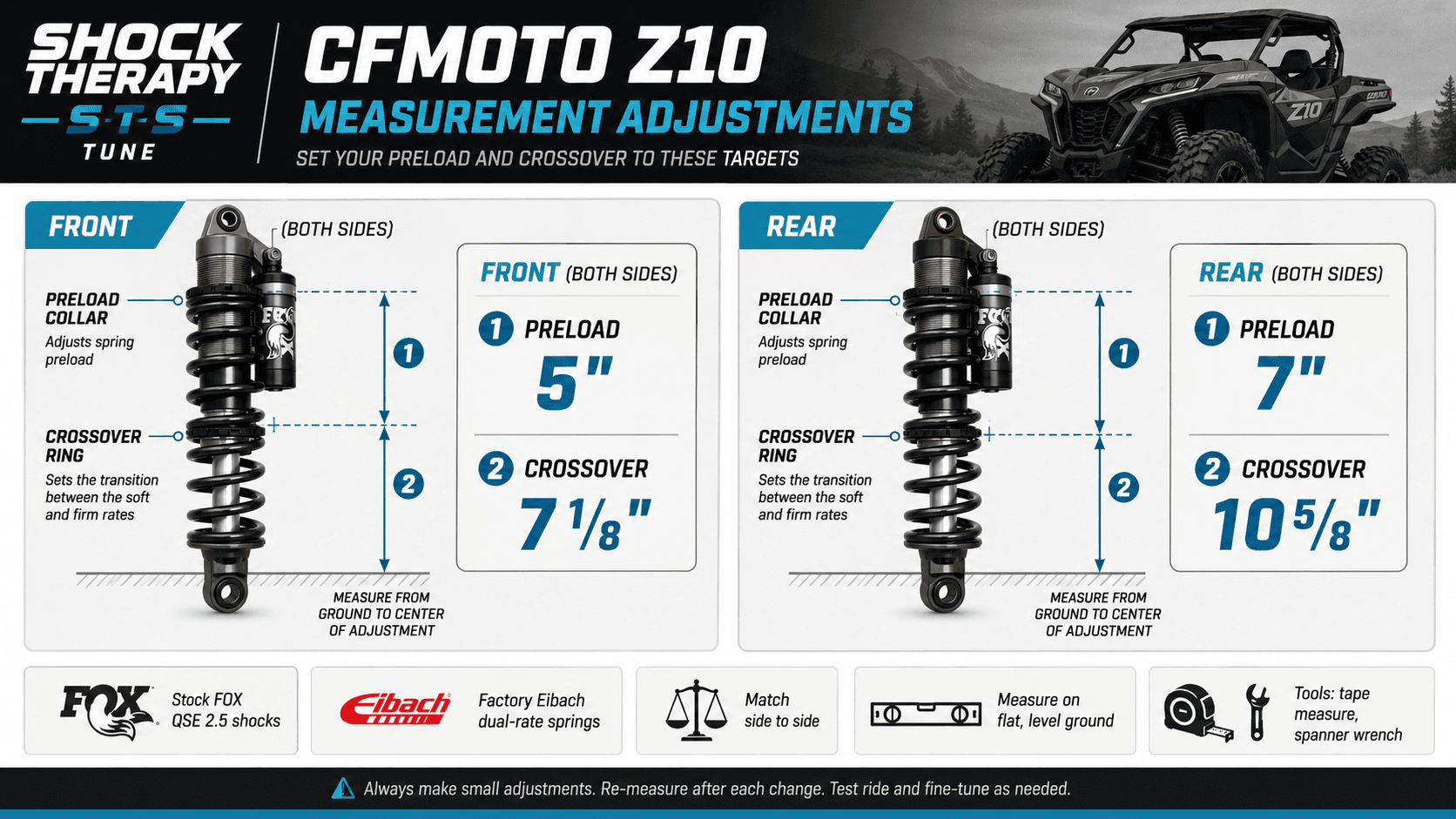
Measure the way Shock Therapy measures. These numbers only line up if the reference points match Shock Therapy's method. Follow Shock Therapy's measuring instructions for where the tape starts and stops on the preload collar and the crossover ring, then set the collars to hit the targets above.
What you need to set it
This is a driveway job. No shock removal, no disassembly. Tools are minimal.
- Tape measure that reads clean fractions down to 1/8 inch.
- Spanner wrench sized for the FOX 2.5 inch preload and crossover collars.
- Flat, level ground so ride height reads true and matches side to side.
- A second set of hands is optional but makes reading measurements faster.
While the collars are exposed, it is a good time to look at shock protection. Shock Therapy Shock Savers slip over any 2.5 or 3.0 inch shock body and keep the shafts free of the nicks that lead to seal failure.
How to set the preload and crossover
- Park on flat, level ground and let the suspension settle. Measure with the machine empty unless Shock Therapy's instructions call for rider weight. Bounce each corner once and let it rest.
- Find the collars on each FOX shock. The preload collar sets ride height. The crossover ring sets where the second spring rate engages. Confirm which is which before you turn anything.
- Measure and write down the current numbers first. That gives a baseline to return to if you want to compare the factory setting to the STS Tune.
- Set the front. Loosen the collar lock, turn the collar with the spanner wrench, and work toward 5 inch preload and 7 1/8 inch crossover. Re-check with the tape as you go.
- Set the rear. Same process, targeting 7 inch preload and 10 5/8 inch crossover.
- Match left and right on each axle. Both fronts equal, both rears equal, so the car sits level and does not pull to one side.
- Lock the collars, roll the machine, and re-check. Rolling it forward and back lets everything settle, then confirm the numbers held.
How to fine-tune from the baseline
The STS Tune is a starting point, not a finish line. Shock Therapy sets it as a middle-ground baseline, so plan to adjust from there based on how the car is loaded and where it runs.
Heavier riders, a full cab of passengers, or a loaded bed will want a touch more preload to hold ride height. Lighter setups can come down slightly for a plusher feel. Fast desert and dune running rewards a firmer, higher stance, while slow rock and tight trail work can run a bit softer. Change one thing at a time, ride it, then decide. The in-cab Soft, Medium, and Firm settings still work on top of all this, since that is compression damping and separate from the spring preload and crossover.
Riders who want to go past what the factory springs can do can look at a dual-rate spring kit and a full re-valve. That is the next step up from the STS Tune, and it is where the rest of the Shock Therapy suspension parts catalog comes in.
Common mistakes to avoid
Measuring on uneven ground
A sloped driveway throws off ride height and makes the two sides read differently. Find flat, level ground first.
Not matching left and right
If one front sits higher than the other, the car handles unevenly. Confirm both fronts match and both rears match before locking anything down.
Confusing preload with crossover
They are different collars doing different jobs. Preload is ride height. Crossover is the spring-rate handoff. Set the wrong one and the numbers will not make sense.
Setting it once and forgetting it
Re-check after the first few rides once everything seats, and any time the load changes or the tires get swapped.
CFMOTO Z10 STS Tune FAQ
Is the STS Tune something I have to buy?
No. It is a free set of measurements Shock Therapy published for the Z10's factory springs. There is no product tied to it.
Do I need new springs or shocks to run it?
No. The STS Tune runs on the stock FOX QSE 2.5 inch shocks and factory Eibach dual-rate springs that come on the Z10.
Will this change my ride height?
Yes. Setting the preload to the STS numbers raises the car off its soft factory stance, and the crossover setting changes where the second spring rate takes over through the stroke.
Does the in-cab Soft, Medium, and Firm still work after I set this?
Yes. That switch controls compression damping on the FOX QSE shocks, which is separate from spring preload and crossover. It works the same before and after the STS Tune.
Does the STS Tune apply to the four-seat Z10-4?
These numbers are the baseline for the Z10. The Z10-4 is longer and heavier, so treat them as a reference point and expect to fine-tune preload for the added weight.
What tools do I actually need?
A tape measure that reads to 1/8 inch and a spanner wrench sized for the FOX 2.5 inch collars. That is it.
How often should I re-check the settings?
Re-check after the first couple of rides once the suspension seats, then any time the load, tires, or riding style changes.
Find fitment parts for the machine on the CFMOTO Z10 parts and accessories page, and read the full CFMOTO Z10 and Z10-4 feature breakdown for the rest of the spec sheet.


